Categories
Uncategorized

Ian Skidmore

He did more farewell performances than Sinatra and,like Ken Dodd, refused to get off the stage while people were still laughing.

But – and I report this with a heavy heart – reporter, broadcaster and author IanSkidmore has finally left the newsroom. He died peacefully, aged 84, at home on Thursday October 3 with his long-suffering wife, thejournalist and award-winning writer Celia Lucas at his bedside.

Skiddy and I never actually met in the flesh and yet became what he described as Great Old Friends. After a certain age you don’t make new friends: you make only old friends. Ours was a purely electronic relationship, depending originally on the telephone, then on e-mail and finally on that miracle called Skype.

About five years ago, when he decided he’d like tocollect all his old columns into what he’d heard was called a Blog, he asked meabout it and my IT-savvy daughter created blogs for the pair of us. His became Skidmore’s Island (the name of a BBCradio ‘station’ he had invented on Anglesey); mine evolvedinto Gentlemen Ranters with Skiddy asits first mainstay contributor.

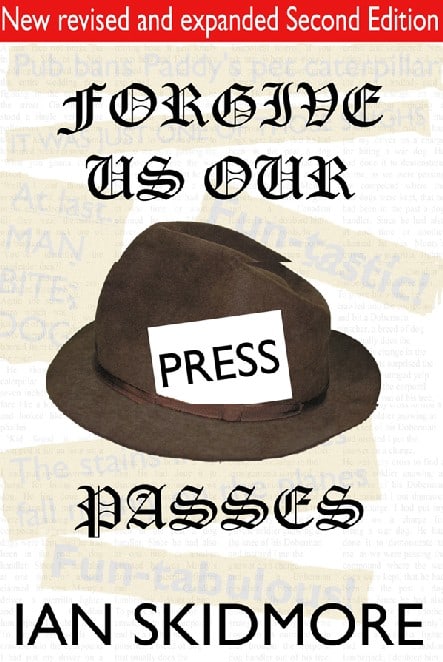
Perhaps because it was electronic, sparks often flewbetween us, for he was a cantankerous old bugger. But five or six years ago when he wrote an extension to his early crack at autobiography, Forgive Us Our Press Passes, and sent photo-copies to a few chums, I suggestedhe revisit and revise and republish the original. The problem there was thathe’d done 24 books and had learnt to hate publishers. So, with nothing betterto occupy my time, I rashly offered to do it for him. The process took awhile to learn but FUOPP came out, toSkiddy’s total satisfaction and joy, and became the first of what has so far been acollection of 30 titles, mainly about, or by, newspapers and journalists.

[Hey… it wasn’t easy. For most of his life as anewspaperman he had dictated his copy over the phone. Spelling and punctuationwere not his strong suits. He argued that Shakespeare had been unable to spellhis own name, at least not consistently, and one of the great poets, I thinkmaybe Wordsworth, had totally ignored punctuation. On radio he had neededneither. When I asked him whether the picture editor’s name was Harrap orHarrop, Skiddy replied: ‘He answers to both.’]

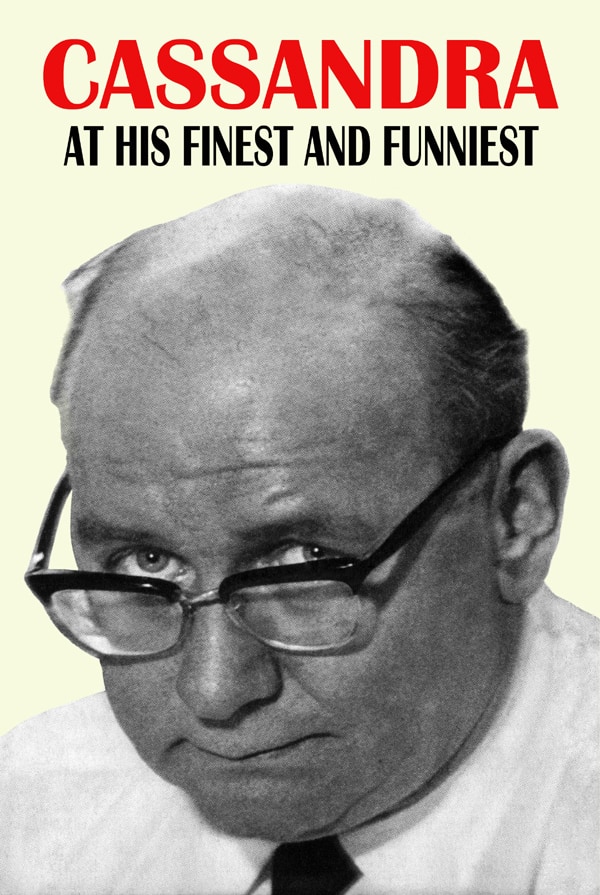
But he was delighted and proud to have been the foundermember of a literary corps that included Cassandra, Vincent Mulchrone, KeithWaterhouse, Hugh Cudlipp, Geoffrey Goodman, Murray Sayle, Harry Procter, Colin Dunne, Tony Delano, Geoffrey Seed and ahost of others whose work he had admired.

So the very least we can do, this week, is revisit andrevise Ranters.

Just for him.

And below we are re-publishing the edition that wasoriginally produced to mark the publication (or republication) of that first book.

For those of you who want still more, you can use thesearch engine in the column on the left. And read some reviews and tributes at the bottom of this page.

Or look up SkidmoresIsland on Google.

Or buy one of his books.

They are available from amazon or – free postage,worldwide – from the BookDepository.

#

March 14, 2008

Forgive Us Our Press Passes

No apologies for devoting this edition of our website to a single topic: this week Ian Skidmore (79 this year) celebrates the publication of his 25th book in as many years, and it’s about his life as a newspaperman.

To lift from the back-page blurb: Journalist, broadcaster and author Ian Skidmore collects rare books and fine wines by choice and unlikely anecdotes and engaging eccentrics almost by accident…

skiddosad

His first, hilarious, account of such encounters was celebrated a quarter of a century ago in the first edition of this book.

The Liverpool Daily Post said its publication identified him as ‘the successor to Tom Sharpe’ and actor Ian Carmichael described it as ‘a comic masterpiece’.

Wales on Sunday said it would be a ‘hard act to follow’.

It was chosen as BBC Book of the Year, had the highest listening figures on Radio Four, and was read twice on the BBC Overseas Service.

The Daily Post described Ian Skidmore as Wales’ funniest columnist, the Western Mail as ‘a great eccentric’.

Now, revisited, revised, and expanded to more than twice its original length it is being published in this special edition.

It is only right to declare an interest at this stage. Forgive Us Our Press Passes is published by a new house called Revel Barker Publishing (motto: If your friends won’t buy your book, what bloody chance has it got?)

It is possible – in fact highly likely – that more titles, for journalists, by journalists, about journalists, will follow.

Regular readers of this website will need no introduction to Ian Skidmore’s writing; he has been contributing to it from the very start. But in the past eight months we have picked up a few thousand new readers, and for their benefit this week’s edition includes the editor’s choice of his offerings.

The only new item is the first one: a recollection that stems from a discussion after a long boozy dinner some 40 years ago. Its veracity in the original telling and in its recounting here cannot, therefore, be totally guaranteed but, as Ranters tend to say, if it isn’t totally accurate, at least it is accurate enough…

#

Monkey business

By Revel Barker

It was one of those bright brisk spring mornings when the day, or maybe at least half of it, was crying out to be written off. The schedule – the Sked – would look after itself. So where to go for a long lunch?

Bill Freeman and Leo White, in the pivotal positions of the Daily Mirror news operation in the north, decided that a trip in the office car to Chester would be about right. They could call on Ian Skidmore, and guarantee a jolly lunch.

They knew exactly where to find him. Skiddy was spending every day at Chester Zoo because he was awaiting the arrival of the first gorilla to be born in captivity in Britain. He’d been booked on regular daily shifts to maintain a permanent watch.

Just for once, Bill and Leo decided, they’d give the guy a break, and take him somewhere different, somewhere decent, to eat. All those lunches at the Zoo restaurant must be boring for a bon vivant like old Ian.

The car rolled up at the gate and they presented themselves at the kiosk with pound notes in hand – they knew the price of admission from Skiddy’s exes.

‘We’re from the Daily Mirror,’ said Bill. ‘We’re looking for the gorilla enclosure.’

gorilla

‘Go straight in,’ said the gateman. ‘We don’t charge members of the press.’

Ian would have been easy enough to spot if he had been anywhere near the Ape House. There, sure enough, was the gorilla. Since Skidmore wasn’t there he would presumably be at the offices, where he regularly entertained his zoo contacts – his other regularly reimbursed item of entertaining was the purchase of chocolate ice cream cones and ice lollies for the pregnant gorilla.

The Curator of Mammals and the Zoo Director welcomed the visitors warmly.

‘Mr Skidmore? Lovely man. Only I haven’t seen him for weeks. He’ll be at the Golden Eagle, beside the courthouse, right now, before moving on to the Symposium Dining Club for lunch. I have all his numbers, in case anybody rings here, looking for him.’

But what, they asked, if a baby was born to one of the animals?

‘Oh, if there’s anything that looks like a story, or a picture, of course I would ring him.’

And what about the gorilla – suppose it gives birth…?

No worries on that score, the curator assured them. The gorilla was male.

No: if they were looking for Mr Skidmore their best bet at lunchtime would be the Symposium.

As they turned towards the exit the Zoo director called them back.

‘You said you were from the Mirror… Before you go, do you need any blank bills from the restaurant?’

Gorilla picture: Edward Rawlinson

#

Button up your overcoat..

By Ian Skidmore

I worry when people, usually mothers, ask me how I got my start in journalism. And not only because the question carries a sub text: ‘If a prat like you can do it, it will be a doddle for a bright child like mine.’

Mostly I hesitate, because everything that has happened to me in my career has stemmed from an embarrassing accident.

In this case going to prison. Only an army prison and I was guilty of nothing – but then they all say that, don’t they?

I suppose I could explain the issue by saying, ‘It was because my greatcoat was unbuttoned, coming out of a pub in Thetford.’

We were a night away from a draft to Palestine and were celebrating in a last chance saloon called the Green Man.

I was a lance corporal in the Black Watch (RHR) who had somehow got mixed up with an RASC unit in the days when Englishmen dominated the Highland Division while the canny Scots all joined corps and learnt a trade.

In my unit all the Scots came from Glasgow. None much more than five feet high. If you were any taller in Glasgow, you got posted to Edinburgh.

Because I was still fastening my greatcoat on the street, I was pounced on by the Town Patrol of burly corporals for being improperly dressed.

A diminutive Glaswegian ran up to one of the corporals and smacked him in the mouth for being impertinent to ‘a Highlander’ (from Manchester, as it happened).

In consequence, we were all charged with assault, taken off the draft to Palestine and sent to Germany.

My charge – ‘in that he did assault six regimental policemen’ – preceded me to my new unit where I was summoned by the CO. He said: ‘I am a very bewildered officer; you don’t look violent to me.’

kilt

I didn’t. Indeed in the kilt I looked like an undernourished reading lamp and I have a photo to prove it.

I explained what happened, but he said there was nothing he could do about it. It was a court martial offence and he would have to remand me.

‘But’ he said, ‘a word of advice: plead guilty. Otherwise they will have to adjourn the court and you will have wasted the officers’ morning. They will have to bring the witnesses over from the UK and they will be very cross with you. Plead guilty and your Prisoner’s Friend will explain the situation.’

I did. He didn’t. And I spent the next 56 days in 3 Military Corrective Establishment at Bielefeld.

When I was released and posted to Bad Oenhausen I decided to desert. On my way to the Bahnhof to get a train to the Hook of Holland I was pounced on by the garrison RSM, a Scots Guard called Graham.

He was very rude to me, suggesting that if I didn’t smarten myself up he would take the red hackle out of my bonnet, stick it up my arse and have me clucking like a Rhode Island Red.

I was very glad when he dismissed me.

To my horror I saw him again five minutes later in the next street. Rather than face him I dodged into the first door I could open. As it happens it was the office of Army PR.

A CSM, Paddy Seaman, asked me what I wanted. I didn’t know what to say, so I asked him if he had any jobs going. I thought I might sweep the floor or make some tea.

He said: ‘Have you any experience of newspapers?’

I thought, that’s a funny question – because, as a matter of fact, I had. I had been a printer’s apprentice at Allied Newspapers at Withy Grove.

I said I had worked on the Manchester Evening Chronicle and Paddy said: ‘Blimey, we haven’t had a newspaper reporter before. Come in and see Kenneth.’

Kenneth, it turned out, was the CO. At the time I didn’t know officers had first names, so I was a little surprised.

I was even more surprised when I met Major Kenneth Harvey. He was a touch fey. I later learnt he had transferred to the Royal Armoured Corps because the black beret brought out the blue of his eyes. What with one thing and another I was very relieved when he asked me to sit down.

All I remember of the interview was the bit where he said: ‘Here’s a chit. Go to the QM and draw your three stripes.’

‘Stripes?’

‘You will join as a sergeant, of course.’

‘A SERGEANT?’

He bridled and his little shoulders shivered.

‘You cannot expect to be an officer straight away,’ he said.

That afternoon, with not the slightest idea what I was doing, I was on my way to cover the Berlin Airlift. Still the biggest story I have ever covered on my own.

But the army always did the unexpected. Some months later when I was Returned To Unit because of persistent drunkenness, another Guards RSM – Irish this time and called Kenny – thought PR was short for provost and appointed me Provost Sergeant of HQ 7th Armoured Division.

So if your child wants a career in journalism, tell him to try unbuttoning his overcoat in Thetford.

#

There Stands The Enemy

By Ian Skidmore

I saw I was down on the diary to cover the Miners’ Gala on Hexthorpe Fields in Doncaster and to interview the guest of honour, Mr Aneurin Bevan.

I found him in the cocktail bar of the Danum Hotel, where in the future I was to sleep in a bath, to beat a UP man in interviewing Charlie Chaplin.

I knew it was the Great Socialist because of his Savile Row suit, the shirt from Thos Pink, the Lobb boots and the Trumper’s haircut. A fragrance by Floris lay heavy on the air.

He was knee deep in aldermen and I hovered uneasily at the edge until he summoned me to come forward and be identified.

‘The Yorkshire Evening News? I am honoured. Come into the body of the chapel and tell me what I might buy you to drink.’

I asked could I have a half of bitter and he said, ‘A HALF OF BITTER?’ in that squeaky voice he had. ‘A half? Of bitter beer? You cannot dip the pen of eloquence in the watery ink of bitter beer… A large Scotch for my literary friend!’

In those days I had Scotch only at Hogmanay and I had never been anybody’s literary anything.

The minutes flew by in the sort of quiet content I expect you get by the yard in heaven. When the time came he put his arm round my shoulders and we walked together to the Fields. Hexthorpe? Elysian.

The miners parted like the Dead Sea and we strode through their ranks. As he climbed on to the dray from which he was to address them he was careful to plant me just where he could see me. He said I gave him confidence. I wasn’t surprised. I assumed that’s how it was with bosom friends.

The miners had been drinking Barnsley Bitter since dawn and it was a hot day. The sun on their heads sent the bitter a-thump and you could see it lifting their scalps. They were looking for someone to tear apart and Bevan gave them someone.

Me.

‘The enemy,’ he explained to them, ‘is not the capitalist in his Rolls-Royce and his Savile Row suit…’ (I thought: there is only one bugger here in a Savile Row suit, but the thought seemed unworthy and I banished it.)

‘No,’ he said in a triumphal squeak. ‘The enemy is not the National Coal Board in their swanky marble offices. No… There stands the enemy!’

And he pointed at me.

‘The prostituted press of our country – that is the enemy,’ he said.

They would have torn me apart there and then but they were transfixed by his eloquence. My notebook was all wet and soggy and I didn’t know if it was rain or tears.

As I shuffled off the field a pariah, I felt an arm round my shoulders. It was him.

‘Mr Bevan,’ I said, ‘I will probably get the sack for saying it, but I think you are a right bastard.’

‘Oh,don’t be like that,’ he squeaked. ‘We both got a job to do. Come and have a drink.’

#

My Life And You Are Welcome To It

skiddy2

By Ian Skidmore

I won a Golden Microphone after thirty years as a ‘celebrity’ presenter on Radio Wales and a fortnight later they dropped me because I was English.

I took the BBC to a Race Tribunal and there was quite a lot of fuss about it. I had been rewarded with many by-lines on the splash of theDaily Mirror over the years. Now I was the subject.

The Head of BBC Wales told the paper I was a Victor Meldrew figure and the editor said I was too old. He didn’t say the same about Jimmy Young, Humphrey Lyttelton or Alastair Cook, to name but a few.

But the BBC gave me a few grand to keep quiet and I did.

Within a month both the Head and the Editor had been sacked.

But as I sit by my pond, keeping herons off my koi, I do ponder a bit. My Manchesteraccent has softened on account of marrying above myself and marinating the throat muscles in the benevolent sweat of the juniper. But I hope and pray I have not lost it.

At the time I had 26 million listeners worldwide to my rants. Plainly my bosses at BBC Wales were not among them. Or they might have noticed that I seldom said Yachi dda (I didn’t even know how to spell it).

The best editor I had in my years of Taff-railing was called Bob Atkins. He was an Englishman too, so he was scuppered from the first day.

He called me to Cardiff and said he enjoyed a programme I was doing at the time.

It was called Skidmore’s Island and how it worked was a producer called Jack King knocked at my door with his tape recorder playing and for the next half hour I talked. About books. About neighbours. If anyone knocked at the door I interviewed them and I played music on my radiogram. No scripts; no conception of what was going to happen.

Unfortunately Bob, who liked a drink, took me to the BBC Club in Cardiff and as he carried me out and poured me into a taxi he said, ‘I won’t ask you to explain how the programme works now…’ (which was just as well; it took me ten minutes to tell the driver where I wanted to go).

‘…Do me a memo.’

I didn’t remember that until I was back home in Brynsiencyn on Anglesey and, still pissed, typed out the following:

Radio Brynsiencyn –

‘This is your smallest outpost. In the customary fashion of BBC bosses I have slept with the entire staff. But since we have been married for ten years it may not count. Our Uher tape recorder is so old it has a pebble glass window and a thatched lid. Our music department is a wind-up gramophone and our record collection includes Teddy Bears’ Picnic and In A Monastery Garden. In fact that is the extent of our collection.’

Then I sealed and posted it and it wasn’t until I sobered up that I realised I had probably dashed the prospect of a glittering career with an audience of sheep and men who wore clothes that looked as though they had been made from the covers of old prayer books.

What happened was that I got a letter from Bob: ‘Forget Skidmore’s Island. I want a series of twenty Radio Brynsiencyn.’

The trouble was I had forgotten by this time what I had put in the letter.

But… I had a title for my programme, twenty slots at a peak listening time, and a Uher tape recorder I bought for sixteen quid on the same stall at Llangefni market where I had found the wind-up gramophone that was my music department. I had an outside broadcast unit, a sit-up-and-beg bike with an errand boy’s basket on the handlebars. I had a wife with a posh voice… and not an idea of what to do with any of them.

It struck me that was par for the course in my ‘parent’ BBC, and decided to do what they did in similar circumstances.

Surround myself with a staff.

Anglesey being an island I needed a foreign editor to handle matters in the dark lands on the other bank of the Menai Strait. Fortunately a chap I had first known on a Bangorweekly paper had just retired. His name was Angus McDairmid and he had some experience of the role. After brilliant coverage of the wrecking of a sailing ship in the Menai Strait he was poached by the BBC and went on to become a distinguished foreign correspondent, covering Washington at the time of Watergate and various wars for the BBC.

Eminently suitable to look after Bangor.

Angus had interviewed world leaders but remained obsessed with his home town, where he was still ‘Gus’ McDermott (his name before being swamped by the Celtic Renaissance of the Sixties).

He used the job to indulge a secret vice. Wherever he had been in the world, however great the crisis, he always found time to visit any town called Bangor. Every week on Radio Brynsiencyn, until his sad death, he told an eager world about them.

The programme was beginning to take shape.

A cleaning staff is vital because broadcasters are a messy lot. Fortunately one was at hand: the love of my life, Rose Roberts, who already cleaned for us and ruled us with a rod of iron. I christened her Attila the Hoover and I was only partly joking. Dirt was terrified of her and dust disappeared at her touch.

Rose had a voice with the carrying power of a giant crane. She had appeared in the programme for only a few weeks when she took a day trip to London. She was queuing for the Palladium and passing pleasantries with her companions that could have been heard in Newcastle upon Tyne.

‘Blimey,’ came a voice from far down the queue: ‘It’s Attila the Hoover!’

No Welsh broadcasting station is complete without a choir. At a lifeboat charity evening I heard a quartet called the Oscars, and immediately recruited them.

A pal of mine, Derek Jones, was a bit worried about his teenage son whose singing voice had just broken.

He was keen on broadcasting so Derek asked if we would teach him the art of interviewing. I was a bit reluctant. Whenever I heard the lad sing, the hair on the back of the head lifted and I had a sense that he had been touched by God.

His name was Aled Jones. Done quite well since, but at that time his preoccupation was a sandwich toaster he had bought with his first earnings and he was forever thrusting toasted sandwiches at you.

But I thought, ‘Give the lad a chance’ and employed him at a fiver a week.

Aled did nothing by halves. He played tennis to county standard; a fine footballer, he was offered trials with professionals, and he was so keen to get his O-levels that in the interval of a concert before most of America in the Hollywood Bowl he sat in his dressing room swotting. Aled went out with my wife on a couple of interviews and picked the art up so quickly he was soon doing them on his own. His dad told me he nearly drove his parents mad practising interviewing on them.

A remarkable boy. Never a trace of nerves. Singing for the Royal Family he forgot the lyric and made up one as he sang along.

He went to record Memories for Andrew Lloyd Webber. ‘Like to do a run-through?’ asked Lloyd Webber.

‘Can we go for a take?’ asked Aled.

They did and the first take was all that was needed.

‘Good God,’ said Webber. ‘It took Barbra Streisand a week to do that.’

His Dad told me: ‘I didn’t like to explain he was in a hurry to watch Match of the Day.’

Aled has been blessed with three gifts. The voice of an angel and his parents, Derek and Ness, who kept his feet firmly nailed to the ground.

When he was awarded his first Gold Disc the BBC planned a huge reception in Cardifffor the award ceremony.

‘Out of the question,’ said Derek. ‘He would have to miss school.’ The BBC had to hire a helicopter for the ceremony; it landed on the playing field of his school in Menai Bridge.

The programme was beginning to take shape: a ‘pirate’ radio station that parodied the commercial radio of the day. We had a signature tune; a group of producers and broadcasters sang the jingles to announce the items; Celia [Celia Lucas, ex Daily Mail: Mrs Skidmore] did interviews and I headed the whole thing with a rant.

Wearing a dinner jacket, of course.

The BBC printed T shirts, ties and mugs with the station logo which started to appear in the oddest places all over the world. We had the highest listening figures on BBC Wales; a ‘club’ of listeners was formed in Boston in the USA and the daughter of a friend started a Radio Bryn fan club at Oxford University.

Islands can be dull paces in winter. Anxious to get away, a neighbour toured the Loire. By the river one day he switched on his radio as he unwrapped a picnic… and heard the signature tune of Radio Bryn doing an outside broadcast – from outside his house.

Celia recorded the programme in our kitchen, rough cut it and sent it to Dewi Smith, head of light entertainment in Wales, for final polishing and transmission.

Then a funny thing happened.

Everyone was convinced it was a real pirate station and I started to get applications for jobs. Women’s Institutes, youth clubs and at least one school asked if they could tour the studios and BBC Controller Ulster heard it while driving across Anglesey.

He rang my editor to ask, ‘Do you have a studio in the cottage or does it come to you via landline?’

We were even a page lead in the Daily Mail.

The series ended seventeen years ago. It is still talked about in Wales.

Everything in what I laughingly call my career was an accident. This was the happiest of them all.

#

Danish Blue

By Ian Skidmore

I am a connoisseur of bad temper. My father was in a perpetual fury, which I put down to being in the trenches at the age of fifteen in the First World War. After the war he joined the police because, I firmly believe, of the opportunities it offered for hitting people.

In a siege in Manchester in the twenties he was shot in the head by an IRA man who later ran a Dublin dog track. In the family it was widely believed he was shot by his own inspector, worn out by my father’s incalcitrance.

Certainly, the inspector had been heard to shout: ‘Take that bloody gun off Skidmore before he kills us all.’

Parades disgusted him. Every year Manchester police had a parade in a Fallowfield park.

The one year they allowed my father to take part he ruined the band’s first concert by shouting: ‘D’ye ken the Refrain from Smoking?’

Probably ill temper swims in our genes. Last year I discovered a cousin, the daughter of a brother of my grandfather, who none of the family knew about. We are not a close family. Except in disputes…

Every Hogmanay we went back to Edinburgh for a family party.

Every year my father would light a cigar to taunt my socialist uncle Tommy, who invented Scottish nationalism long before it became fashionable and was more Scottish than Harry Lauder. Probably because he was born in Newton le Willows, about which my father reminded him every year.

The youngest brother, who tried to pacify him, was himself turned into a pillar of fury when my father told him: ‘I didna see you at Paschendale.’

There was always a fight on the early evening. The women placidly moved their chairs to the walls of the room where they sat nibbling shortcake and gossiping, while the six brothers rolled fighting at their feet. Fighting, that is, until 11.55 pm when my Auntie Jeannie would say: ‘D’ye no ken the time?’

The brothers would get up, dust themselves down. And we would all join hands and sing Auld Lang Syne.

My step father in law, another Scot, improbably called The Menzies of Pitfoggle, was a GP in the Fens. A luckless journalist who went to him for advice on a sexual problem was chased down the drive of the surgery by Pitfoggle, hurling obscenities and, for all I know, pillboxes and bottles.

Yet, compared with Maurice Thompson, a photographer I worked with on the Yorkshire Evening News in Doncaster, they were, every one of them, tiny beams of sunshine.

The first time we worked together I was immediately rebuked for getting into his Morris Minor with mud on my shoes. Nervously I lit a cigarette and he launched another tirade about ash disposal.

How we ever became friends I do not know, but it came as a shock to discover he liked me.

Certainly it was nothing he said.

So it was a surprise when years later he rang me and asked whether I fancied a day trip to Copenhagen.

I am not a traveller. When we lived on the Isle of Anglesey my wife claimed I needed Kwells before I would cross the Menai Strait and it is quite true I suggested a holiday once in Beaumaris, a pretty town about five miles from our home in Llanfairpwllgwyngoghchewernynllantisilogogogch. I never did learn how to spell it, much less pronounce it. And one of the reasons I was loath to leave it was the dread of getting lost and being unable to tell a taxi driver where I wanted to go.

But in my own defence, I did offer to break the journey at Menai Bridge and the draught Bass in the Bull in Beaumaris was ale that, to quote Beaumont and Fletcher ‘would make a cat speak.’ I digress.

Maurice had been hired to take photographs of an unusual PR stunt. British Ropes in Doncaster had been commissioned to make the huge ‘ropes’ from which a bridge was to be suspended over the Strait of Jutland. As a gesture of thanks, the workers who made the ropes were invited over for a day to see them, literally in post.

This happened in those earlier, happy days, before they invented holidays abroad. When holidays in Scarborough or Whitby were permissible but Blackpool or Morecambe were considered a bit on the showy side. No-one who valued his place inYorkshire society would go to Bournemouth.

Denmark? It was Star Trek country and everyone was very excited.

A busy day ended with a banquet in the Chinese Pagoda in the Tivoli Gardens. Maurice and I got there early in case there was a bar. There wasn’t, but we watched with interest as chefs patterned complicated devices in lump fish roe over the salads that stood by every plate. Clearly, they hoped the roe would be mistaken for caviar. It wasn’t.

The first diner to arrive called his mate. ‘Bloody hell, Harry. There’s caterpillar shit all over this lettuce.’

One by one, the British Ropers scraped rigorously at their leaves.

The man who had discovered this evidence of the filthy habits of foreigners also singled me out. ‘Tha’rt bloody journalist, ist tha?’

I admitted I was. ‘Nowt fresh to you then, this Abroad?’

Nowt, I lied.

‘Sithee,’ he said, leaning over. ‘Thi ’ave a lot of that sex stuff abroad, doan’t thi?’

Thi do, I said.

‘Weer does it go on, then?’

I had no idea. I said near the railway station because that’s where it went on when I was doing national service in Germany, my only other experience of Abroad.

‘A’ll tell thee what,’ he said, ‘There’s three hours before t’plane. We’ll ’ave a bit of a dander, just thee and me. Just to see, like.’ So we did.

The sex shops were a revelation to both of us. He was particularly exercised by loops of stiff hair, designed for putting on penis ends, to stimulate partners. ‘Dear, dear,’ he said, profoundly shocked, because he was at heart a God-fearing, respectable man.

He staggered off into the crowds. He was also a very tall man. I could keep track of him as he stumbled, horrified by the depravity and anxious to return to the safety of his world of darts and dog walking. A piece of totty detached herself from a wall and surged towards him like a determined trout.

I caught up in time to hear her proposition him and I saw the back of his neck deepen to vermillion.

‘D’yer mind,’ he said. ‘It’s the wife’s birthday tomorrow.’

#

No socks, please

By Ian Skidmore

I hate sharing rooms. In PR, in the army, I shared a room with a chap who was called, not unfairly, ‘Filthy Sykes’. Admirable in many ways, he amassed a collection of single socks, all indescribably dirty, that would have had any decent incinerator retching with desire. They festooned every surface, door top, window frame and light fitting in the room and made cosy nests on most surfaces.

After the army, Sykes went to work for a newspaper in Canada and died, which is as near as life gets to an oxymoron.

My greatest regret, however, is the night I shared a room in the Westminster Hotel reporting on the ‘Mummy in the Cupboard Murders’ in Rhyl, with Terry Stringer.

I hasten to point out that Terry was the most fastidious of men, whose carefully matched and laundered socks were beyond reproach.

It was an unlucky room. I had it to myself before Stringer arrived and it was the scene of bitter humiliation.

From Rhyl I was sentenced to being northern night news editor of the Mirror, an experience much worse than my earlier incarceration in an army prison.

The assembled reporters gave me a dinner and the management of the hotel were so pleased with us, they baked me a cake. Understandable – we had spent more behind the bar than they had taken in bookings so far that season.

The cake was topped by a tasteful mummy, wrapped in embalming clothes in a marzipan coffin.

One day I hope to identify the guest who sold the story – ‘shocked hotel guests appalled by gruesome cake’ – to a Sunday paper.

During the dinner I sat next to a lady who had set up a slimming couch in one of the suites. When you lay face down on its moving panels, it gave erotic sensations of such intensity Tom Cooper of the Daily Telegraph wanted to get engaged to it.

The lady asked if there was anything I regretted about leaving the road and I said yes there was. I said everyone else came back from out of town jobs with tales of love making that would make your hair curl.

Me? Nowt.

She said well I will tell you what. After dinner go off to your bedroom and as soon as I can I will join you.

So I did. I bought a bottle of wine, I put on my silk dressing gown, scattered Old Spice about the room like May Blossom and waited.

She arrived.

I leapt into bed.

She followed.

Then she whispered in my ear. ‘You will have to hurry up. I am meeting [name deleted] at midnight.’

The last week on the road wore on. Terry Stringer was sent out to take over and we had to share rooms. Naturally I gave him most of the work and I spent my last days wandering about Rhyl hurling gold coins at stall holders, winning teddy bears, sticks of rock and on the last Sunday, a budgie.

In a plastic cage.

I was sitting at a bar table in the Westminster chatting idly with the budgie when we were joined by Reg Jones of the Daily Mirror.

‘What’s that?’

‘It’s an ostrich,’ I said with heavy irony.

‘No. The cage. It’s disgusting. The poor bird can hardly move. You want to get it a decent cage.’

‘Its Sunday, the pet shops are closed.’

‘Then find out the home address of one and get him to open his shop.’

So I did. It wasn’t easy. But I did.

‘Now are you satisfied,’ I said.

‘No’ he said. ‘It’s got nothing to play with. Budgies like little mirrors and see-saws and bells they can ring with their beaks.’

‘It’s Sunday and I am not getting the poor bugger out again. He’ll be having his dinner.’

‘Use your initiative. Go to an amusement arcade and win them on one of those grab cranes.’

So I changed a fiver into low denomination coinage, went to the amusement arcade, found a grab crane that offered various novelties on a hillock of liquorice torpedoes, and set to work. Winning nothing but grabs full of liquorice torpedoes.

I had amassed enough torpedoes to sink the German navy when I felt a tap on my shoulder.

I turned round and saw a man in a brown dust coat. At first I took him to be the Mayor of Blackpool. But it wasn’t a chain of office he had round his neck; it was a string of keys.

He questioned me abruptly and I explained I was trying to win some toys for my budgie.

Pushing me to one side, he opened a window in the machine and collected a variety of plastic toys, thrust them in my hand and said: ‘Now piss off and give these kids a chance.’

For the first time I noticed the queue of impatient children, clutching their pennies.

That night in its palatial cage, surrounded by toys, the budgie passed a sleepless night.

I had to wake Stringer twice to complain that his snores were keeping my budgie awake and the next day I had to tell the desk to recall him. It was the only way the budgie could get a decent night’s sleep.

Two days after I got it home the budgie was eaten by the cat.

I think it was the cat. But, in those days, I had a very funny wife…

#

In the line of fire

By Ian Skidmore

News agencies, weekly papers, evening papers, trade magazines, national dailies and Sundays, Kemsley Newspapers, J P Taylors Colour Printers, The Black Watch (RHR) – twice, which I think may be a record – one school and two clubs…

I have been sacked by experts.

My shortest period of employment was a day and a half, working for Jimmy Lovelock, proprietor of Stockport News Service, owner of the only fornicatorium in Cheshire and the only man to organise an abortion on the National Health, when abortions were not even legal.

Editor of a weekly newspaper in his early twenties, he had been crippled with polio as a child, but nevertheless became a mountaineer, a pot-holer and a member of the expedition that climbed Nuptse, Everest’s smaller sister.

A remarkable man.

Jimmy introduced me to the staff, which took up most of the first day.

The staff was an odd little chap called Mickey. First of all we had to find him, and that was never easy. A year after his arrival no-one knew Mickey’s surname and I don’t think anyone ever found out where he lived.

He was invariably respectful and called Jimmy ‘Master’.

Mickey had a single purpose in life: to discover how millionaires made their first thousand pounds. Their memoirs, said Mickey who had read them all, always included the phrase, ‘with my first thousand pounds I bought…’ but they never explained where the thousand pounds came from. He suspected they had nicked it; but, scorning that as being too easy, he tried dealing. He only really mastered the art of acquiring. Disposal escaped him. To Jimmy’s puzzled chagrin he used the agency’s office as his warehouse. There were racks of clothes of improbable sizes, a job lot of string-less violins picked up for a song, inevitably tuneless, twenty gross of heavily tinselled cards wishing A Happy Christmas for 1948, that he had bought in 1951, and other less saleable items.

You could never find a pen there, or even a typewriter; but anyone in need of a string-less violin was easily accommodated.

Next he tried gambling, a curious reversal. Disposing was child’s play. Acquiring he never quite mastered.

He had one suit that he wore to the office, except on the days when he wore a mackintosh, in the hope that ‘Master’ would not notice he wore only a shirt, tie and underpants beneath, having pawned the suit. The gartered socks were a give away.

By the time I arrived Jimmy had taken to paying him by the day.

The second day there I got an out-of-town job; I was after all the only member of staff who could be relied on to turn up in a suit. Wilmslow magistrates court, which in those days could be reached from Stockport by train, was hardly outer space but Mickey anxiously took me for a couple of pints to stiffen the sinews. One pint led to another and by the time I got on the train I was exhausted, fell into a deep sleep and woke up inCrewe. I had seen enough Hollywood newspaper films to know what to do. I rangStockport on a transfer charge call and asked Jimmy to wire me my fare back to the office.

I was touched that he went further. He drove all the way to Crewe to collect me. I see now that it gave him a greater opportunity for an in-depth character assessment, but at the time I thought it a charming gesture.

We were nearing Stockport when he ended his assessment.

‘Skiddy,’ he said. ‘We have two options. Either I employ you or we stay friends.’ Again I was very touched, it was my friendship he valued.

He generously paid me for a day and a half but despite the joint urgings of Mickey and myself refused to add the one and a half hours holiday money to which we felt I was entitled. After nearly sixty years the debt remained unpaid, though I had over the years mentioned it many times, even sent bills to his retirement home in Spain. He always copped me a deaf ’un.

In the fullness of time he came to work for me, doing shifts when I ran the night desk on the Sunday Pictorial. I tried to have my holiday pay docked from his shift money, but the linage department was obdurate. No amende honorable, not even when he made a fortune doing night shifts for six nationals outside a vicarage in Cheshire, in case the Vicar of Woodford sneaked back in the night.

In fairness he did bring me a kukri back from Nepal when he climbed Nuptse and I treasure it to this day.

I was especially touched because he was very cross. Picture editor George Harrop and I had sent him a telegram as soon as the news broke of his successful attempt. ‘Is there froth on the top?’ it read, rather cleverly we thought.

We didn’t know that it would take the Sherpa who delivered it three days to climb the mountain.

Mickey? No idea. The last time we met we were having lunch with Lord (Tony) Moynihan when his wife’s tits fell out and somehow, in the excitement of that, I never got round to finding out whether Mickey made his first thousand, but I was pleased to see he was not wearing his raincoat.

#

Founding a dynasty

By Ian Skidmore

Regular readers will recall that I became a reporter by not fastening my greatcoat in Thetford. My son, youngest daughter and grand-daughter became journalists, turning me into a dynasty, because of something that happened to me in bed.

At my romantic best, my bed activities over the years would bring a smile to the face of an Easter Island statue.

Even on my own in bed I am funnier than alternative comedy; though, let us face it, I have seen acne eruptions funnier than alternative comedy.

When I was resting between marriages, and on nights when I was sober enough to make it to the bedroom the same night I started up the stairs, I had a ritual I used to perform.

About the only thing I had won custody of in my first divorce was the Teasmade, a combination alarm clock and tea maker; though even here I had to promise to bring it up in the Jewish faith.

I would activate the Teasmade, climb into bed, carrying with me a book to read and an apple to eat. Supine, I placed my false teeth on my stomach. Thus, if I felt the pangs of hunger, it was the work of a moment to pop in the false teeth and attack the apple.

Alas, on the night under advisement I neglected to put the pipe from the kettle into the hole in the lid of the teapot of the infernal machine. In fact it hung like the sword of Damocles over what I laughingly called my chest.

Worse, I fell asleep with the apple, the book and the false teeth in line ahead on the belly.

On the dot of 7am the kettle performed its function, heating the water to boiling point before waving it off on its journey along the pipe, which, you will recall, was poised over my ‘chest’.

The jet of boiling water hit it, waking me and causing me to leap into the air for just long enough for the dentures to slip off my belly and position themselves beneath me, so that when I landed I gave myself a very nasty bite in the backside.

I was dining at the Chester Grosvenor that night with my friend Long Langford and fellow members of the Confrerie de la Chaine des Rotisseurs. (This has nothing to do with the story really but as a piece of name-dropping would be difficult to beat.)

Personal daintiness decreed that I should not put the teeth back in the mouth. The Ninth Baron was not best pleased.

‘Why haven’t you put your teeth in?’ he demanded.

‘If you knew where they had been, you wouldn’t ask,’ I said.

I was surprised a year later to open my daughter’s school newspaper and find she had written an account of the unhappy incident for the amusement of her peers. The response was such that she and my son both decided to take up careers in journalism.

Now my granddaughter is working for the PA. It’s an ill wind up…

#

REVIEWS

IanSkidmore’s Forgive Us Our Press Passes should be made required reading forevery child-in-a-suit populating what passes for our newsrooms these days.

Grey Cardigan, Press Gazette

It’s theGreat Comeback… Ian Skidmore’s joyful account of the Golden Days of British nationalnewspapers has been thoroughly revised and more than doubled in length since thefirst edition 25 years ago.

Effectively it is a new book – twice as entertaining and informativeas its predecessor. No one will regret buying it again.

For Daily Mirror journalist “Skiddy” muses on the changes in nationaljournalism in recent years. His misgivings on the massive entry of university graduatesare clear. And his erudition and sense of humour are apparent on every page.

Ian is truly a man of many parts and has worked as hard as hedrank. He has now written 26 books – histories, biographies, fiction, comedy. Formany years he was a BBC broadcaster with many millions of listeners round the world.His regular talks toAustralia drew record audiences down under.

– Stanley Blenkinsop, Daily Express newseditor, 1969-86


When FleetStreet was demoted to a mere address, ‘time, gentlemen, please’ was called on amarathon binge that had produced some of the greatest stories in tabloid press history.

Stories that would never make the papers.

These unprinted legends circulated secretly among an elite handfulof national newspaper reporters and photographers – colourful characters whose ownoutrageous tales often eclipsed those in the headlines they created.

Now that well-paid jobs and bumper expense accounts are no longerat stake, vintage scribe and broadcaster Ian Skidmore blows the whistle on the jollyjape that was journalism in the 50s, 60s and 70s.

Forgive Us Our Press Passesis a surrealyarn of the slapstick and wit shared by a crackpot but talented crew of hacks whosomehow produced the greatest newspaper circulation figures in the history of theworld press… between pub opening hours.

Only a Methodist, a tailor’s dummy or a university journalismstudent could fail to split his sides at the anecdotes in this hilariously written,warts-n-all account of the media circus BEFORE they sent in the clowns.

I wonder how many old hands have bought this book… and carefullyhidden it from their wives.

– Neil Marr

The Scallygwagis back – and twice as much of him. Ian Skidmore, doyen of national newspapermen,radio and writing, relates his quirky anecdotes in his usual ebullient style ina new version of his original book.

He doesn’t pull punches as he talks about the Grand Old Days ofJournalism – as it was and should be. The cycle of fun and fact, hard news huntingand companionship come alive under the pen of Skidmore.

Written from the perspective of a journalist who worked in thedays of typewriters, phoned copy, notes on cheque book stubs, and when media studiesmeant scanning the opposition for their take on your story – if they had it!

Forgive us our Press Passes should be required reading for all journalism students, and journalists –but not their wives or girlfriends. Brilliant.

– Ken Ashton

I firstmet Ian Skidmore when I was an innocent young reporter making my way on nationalnewspapers. My bosses warned me: Stay away from Skiddy. Of course I didn’t.

He introduced me to enormous dressed Pimms served in enormouspots in the Bear and Billet and taught me that being a national newspaper reporterwas about having fun. Lots of it.

There is no way the po-faced ‘media studies’ Gestapo trainingtoday’s young reporters would let them have sight of this marvellous tome in caseit corrupted them. They should be made to read it.

He brings back to life some of the marvellous characters of mynewspaper youth, men who taught youngsters how to be proper reporters.

Guardianistas reading this book will have alltheir twisted prejudices confirmed, others may not believe some of the tales, butfor me it was a rollicking good read.

And it took me back to the days sitting at his knee in the Bearand Billet and other taverns and listening to his tales. In some cases the nameshave been changed or even omitted – to protect the guilty!

– Alastair McQueen


In the courseof a fruitful and liquid life, Ian Skidmore has got himself into more scrapes thana potato peeler. He is large in body and spirit; a gregarious journalist of therobust school. His anecdotes are numerous, varied, and occasionally bizarre –

Informants were necessary because I was getting a great dealof aggravation from local linage pools. Things got so bad, indeed, that I used togo often toChester zooand play with a baby gorilla who became a fast friend. I would buy him the odd icelollipop. He liked the ones that were chocolate-covered best, but friendship isnever cheap, and we would play about and wrestle on the green lawn in front of hisquarters on long evenings after the zoo had closed…’

Or –

When we walked down the aisle at St Paul’s Church I was completely broke. Happily, during the reception richrelatives kept pressing money on me…’

He writes fluently and perceptively about the rigours of life,which have tended to congregate around his ample figure like a crop to be garneredin print at the right moment. In this turmoil of character and characters, he casuallydrops a name or two here and there to show his proximity to class as well as glass,but why not, indeed?

Anyone buying Forgive Us Our Press Passesshould bend the covers back at page 75 for easy accessin future. For here is an account of his meeting with Aneurin Bevan, one of thetowering politicians of our era. It is a Dickensian-like story of innocence, betrayaland deception and absolutely compelling.

Skidmore’s best, in my view.

– Geoffrey Mather


###


Categories
Uncategorized

Sitemap

Categories
Uncategorized

Bodoni, Friday

Still in holiday mode but, unable to stop, we came across a quote via the editor’s blog of Press Gazette lifted from a story in The Independent, that was an extract of a piece in GQ magazine.

On the off-chance that there are readers out there (difficult to believe, I know, but just indulge me) who don’t read any of those publications, let me explain: it’s an interview by Piers Morgan with Alan Rusbridger.

They were supposed to be discussing the Guardian editor’s new book, but never got round to it. It’s actually old stuff, which I hadn’t noticed on first reading, but it was all new to me. Nevertheless, it makes interesting reading – not least the passing mention that Mr Rusbridger trousered ₤520,000 for his labours in one year.

What appears below (with permission, of course) is, as I say, an extract. If you want the full version, you’ll need to wait for Mr Morgan’s next book, in April next year.

Anyway, we’ll be back next week, having extended our break on account of festa time here on Ranters Island. The village (Helvetica) is en fete all week, culminating in a riot of fireworks to commemorate the feastday dedicated to our patron saint, San Serif.

Meanwhile, we can still accept copy…


What happened when the Guardian editor met Piers Morgan

As the Editor of ‘The Guardian’, Alan Rusbridger presides over an institution that prides itself on occupying the ethical high ground. But how would he stand up to scrutiny when ‘GQ’ magazine sent Piers Morgan along to grill him?

I’ve always thought that editing The Guardian must be a right old moral maze. Journalists at the paper love to see themselves as ethically, morally and intellectually superior to tabloid hacks. Yet there’s nothing that those liberal sandal-wearers like more than to lift all the juicy details of a sex scandal broken in the “gutter press” – while pretending to be outraged at the same time, obviously.

And Guardian hacks would think nothing of exposing some errant politician’s personal peccadilloes – and then going home and doing exactly the same thing themselves. The paper’s editor, Alan Rusbridger, is the prime exponent of this art form. He spent a decade filling his boots with salacious material from papers I edited while pronouncing regularly about how disgusting it all was.

He also unleashed his reporting hounds to harass me from time to time, while insisting that he was not a public figure and therefore should be spared the investigative rod of scrutiny himself at all times. And yet we became good friends, dining occasionally at champagne-socialist bastions such as the Ivy, where he would crack open the Montrachet and lobster, and bemoan the excess of modern public life.

Despite his perpetual rank hypocrisy, I am very fond of Rusbridger and his paper. The Guardian plays an important role in our society, and acts as an effective foil to right-wing papers such as the Daily Mail.

But I’ve yearned to sit down one day with him and confront him about his contradictory demons. I finally got the chance when I was invited to the great man’s office in Farringdon Road, London, ostensibly to discuss his new children’s book, The Smelliest Day at the Zoo.

Unfortunately, we never got around to that in the one-and-a-half hours that we locked horns. What we did discuss was sex, drugs, scandal and morality; which, I hope you will agree, is a damned sight more interesting.

It was a lively, edgy, confrontational and deliciously enjoyable encounter. And I was right. Editing The Guardian is indeed a right old moral maze.

Piers Morgan: How are you feeling, Alan? You seem to have lost about half your body-weight since I last saw you.

Alan Rusbridger: I’ve been on a WeightWatchers diet. You know what these jobs are like. You don’t exercise, you eat and drink too much… so I had got a bit porky.

PM: How porky?

AR: I was a trouser-size 38.

PM: That is porky. So, how are you feeling now?

AR: Well, if you stop and think what two stones is, and realise you were lugging two stones of lard up and down stairs, then obviously you feel a lot better.

PM: But did you keep on drinking throughout the diet?

AR: Oh yes. I couldn’t have done it if I had to give up alcohol.

PM: And has the diet improved your sex life?

AR: I, er…

PM: Come on, Alan. It’s a legitimate question.

AR: It’s not. I’ll pass on that one.

PM: Are you putting the heat on larger members of your staff now, urging them to drop the flab?

AR: Well, there are, in fact, very few fatties who work on The Guardian.

PM: Is that a deliberate policy?

AR: Yes. We are very sizeist.

PM: How is your new Berliner-sized paper actually doing?

AR: It is doing, more or less, what we expected.

PM: That’s what I used to say when things went badly.

AR: Do you want to see charts?

PM: No. I always used to bamboozle my critics with charts. How did you sell last week, then [December 2006]?

AR: About 386,000.

PM: And what were you selling before the Berliner redesign?

AR: We were down in the 360s, 370s. The one mistake we made was to take out 10,000 bulks, which made the figures look worse than they were.

PM: But you did that to make the relaunch look better than it was.

AR: No, we did that at the time of the relaunch.

PM: I thought you did it a couple of months before the relaunch.

AR: Er, well, we took them out a few months before and didn’t put them back for the relaunch.

PM: So I was right. You did it deliberately. It’s an old trick.

AR: We did. But we didn’t shove them back in; that’s the point.

PM: It’s not my point.

AR: We were too honest.

PM: Hmmm…

AR: Monday-to-Friday sales are a struggle for everybody. The thing that props up circulation is DVDs, wall-charts, posters etc. People like charts: they sell 15-20,000 extra copies a day.

PM: Do you assume that editing is a job for life?

AR: No, I assume that all careers must come to an end at some point.

PM: But Guardian editors, tend to have the professional lives of several elephants. What would it take to be fired?

AR: When you’re appointed, the only thing you are told is to edit the paper “as heretofore”.

PM: That seems suitably incomprehensible for The Guardian.

AR: I think it means that The Guardian is a liberal, progressive, intelligent, internationalist paper which operates to certain ethical standards. And that’s what I have to do. So if you betray that edict by backing UKIP in an election, for example, you would have to leave.

PM: I’m talking more about personal conduct. I read an interview in which you said that what mattered most between a paper and its staff and the readers was trust. Do you think you have to be as trustworthy privately as you are professionally?

AR: I think you have to be trustworthy in your professional life.

PM: Not personal life?

AR: [Silence for 10 seconds] I like to make a distinction between professional and private in everything we write about.

PM: But when David Blunkett admitted in his diaries that he couldn’t concentrate on the Iraq war dossier debate in Cabinet because he was in emotional turmoil over his affair, isn’t that where private and professional gets a little blurred?

AR: If that impacted on his life…

PM: A private or public matter?

AR: I wouldn’t, er… [pauses] go looking for this kind of thing.

PM: Really? Isn’t it a matter of public interest if the Home Secretary admits he couldn’t focus on a dossier that sanctions war because of the turmoil surrounding his affair?

AR: Well, I wouldn’t go looking into it, if that answers you.

PM: No, that wasn’t my question. I asked if it was a public matter or not. It strikes me that by his own admission, therefore, his private life is directly impacting on his public work.

AR: If that’s his own judgement…

PM: But The Guardian serialised his own book with that very admission. It doesn’t mean you read it, granted…

AR: It was 900 pages. I didn’t read it all.

PM: It amuses me when you “serious” editors claim you don’t do private-life stuff, because you do. You wait for the tabloids to do the work and then pile in, repeating the juicy bits while condemning the tabloid intrusion. If you feel that strongly about it, why repeat the original invasive material? Did you cover the Deputy Prime Minister, John Prescott’s dalliance with [his secretary] Tracey Temple?

AR: We did in the end, yes.

PM: Why “in the end”?

AR: There isn’t a pat answer to that. There are very few of my broadsheet editor colleagues who, if someone came to them and said, “I’ve been shagging the Secretary of State for, er – I’m trying to think of a department that doesn’t exist – er, pensions and culture, are you interested?”, would say “yes”. None of us do that kind of stuff as original journalism. But, once stories are out, then if your job is to report what is going on in society at large then there comes a point when you can’t ignore them.

PM: I find that a totally fatuous argument. Either you believe that Prezza’s affair is in the public interest, or you don’t. If you think that the affair itself is not a public matter, the braver thing to do is not to report it all. The Independent used to have a policy of never reporting on the Royal Family, and I thought that was admirable and that it lacked the total hypocrisy of your position.

AR: It was brave, but in the end they looked stupid and stopped.

PM: If I gave you concrete evidence Charles and Camilla were splitting up, would you publish it?

AR: Yes, because that is about the relationship between future monarch and wife, the future King and Queen.

PM: And if I told you that Charles was leaving Camilla because he was having an affair with Victoria Beckham, would you publish that part of the story?

AR: Well, again, because marriage in monarchy is more part of the job, then it is more relevant; rather than the fictional minister I discussed earlier.

PM: Isn’t being Deputy Prime Minister a fairly important job?

AR: Yes, but the broad distinction that editors in my end of the market make is that what politicians do in private, consensually, is up to them.

PM: Literally, anything?

If it’s legal, yes.

PM: So if I showed you evidence of David Cameron snorting cocaine, you would publish that because it’s illegal, right?

AR: Yes, but I wouldn’t spend a lot of time going looking for it. I think illegal behaviour by a possible future prime minister is in the public interest.

PM: Don’t you think that Cameron should have been honest on whether he’d broken the law?

AR: I’d have been happier if he’d come out one way or another. But we all knew what he was saying by refusing to answer it.

PM: Did we?

AR: Didn’t we?

PM: Would you answer that question? Are you a public figure?

AR: Not really, no. I am accountable to the Scott Trust [owner of the Guardian Media Group], and I make The Guardian’s journalism more publicly accountable than any other editor in this country.

PM: I only ask, because I remember The Guardian treating me as a public figure when I encountered various scrapes as an editor. Do you think that your own life would stand up to much ethical scrutiny?

AR: In terms of the journalism?

PM: No, I mean privately. Do you consider that infidelity is always a private matter for public figures, for instance?

AR: I think what people do legally and consensually is private.

PM: If I asked you if you had ever taken illegal drugs, would you feel compelled to answer?

AR: No, I’d say to you to mind your own business.

PM: What’s your current salary?

AR: It’s, er, about £350,000.

PM: What bonus did you receive last year?

AR: About £170,000, which was a way of addressing my pension.

PM: That means that you earned £520,000 last year alone. That’s more than the editor of The Sun by a long way.

AR: I’ll talk to you off the record about this, but not on the record.

PM: Why? In The Guardian, you never stop banging on about fat cats. Do you think that your readers would be pleased to hear that you earned £520,000 last year? Are you worth it?

AR: That’s for others to say.

PM: Wouldn’t it be more Guardian-like, more socialist, to take a bit less and spread the pot around a bit? We have this quaint idea that you guys are into that “all men are equal” nonsense, but you’re not really, are you? You seem a lot more “equal” than others on your paper.

AR: Er… [silence].

PM: Do you ever get awkward moments when your bonus gets published? Do you wince and think, “Oh dear, Polly Toynbee’s not going to like this one.”

AR: Er… [silence].

PM: Or is Polly raking in so much herself that she wouldn’t mind?

AR: Er… [silence].

PM: Are you embarrassed by it?

AR: No. I didn’t ask for the money. And I do declare it, too.

PM: But if you earned £520,000 last year, then that must make you a multimillionaire.

AR: You say I’m a millionaire?

PM: You must be – unless you’re giving it all away to charity…

AR: Er…

PM: What’s your house worth?

AR: I don’t want to talk about these aspects of my life.

PM: You think it’s all private?

AR: I do really, yes.

PM: Did you think that about Peter Mandelson’s house? I mean, you broke that story.

AR: I, er… it was a story about an elected politician.

PM: And you’re not as accountable. You just reserve the right to expose his private life.

AR: We all make distinctions about this kind of thing. The line between private and public is a fine one, and you’ve taken up most of the interview with it.

PM: Well, only because you seem so embarrassed and confused about it.

AR: I’m not embarrassed about it. But nor do I feel I have to talk about it.

PM: Do you like money?

AR: I remember JK Galbraith saying to me once: “I’ve been rich and I’ve been poor, and rich is better.” You can have an easier life if you have money.

PM: I heard you bought a grand piano for £50,000.

AR: £30,000 – the most extravagant thing I’ve ever bought.

PM: Are you any good at it?

AR: I can play quite well, I suppose. I rarely inflict it on anyone else, though.

PM: Is it true you play naked?

AR: No. I usually play fully clothed in the mornings.

PM: What about your cars? Are you still driving that ridiculous G-Wiz thing around?

AR: Yes, and I love it.

PM: But I also read that you use taxis to ferry your stuff to and from work, which sort of negates the green effort, doesn’t it?

AR: That story was a bit confused. I used to cycle to work sometimes, and if I was too tired at the end of the day then I would fold up the bike and get a cab home, yes. But about a year ago I was nearly killed in a nasty accident on my bike so I gave up cycling and bought the G-Wiz.

PM: Any other cars?

AR: A company Volvo estate.

PM: A big gas-guzzler.

AR: Yes.

PM: Bit of a culture clash with your G-Wiz, then?

AR: Let me think about that. The problem is that I also have a big dog, and it doesn’t fit into the G-Wiz.

PM: I’m sure the environment will understand. Any others?

AR: My wife has a Corsa.

PM: Quite an expansive…

AR: Fleet…

PM: Yes, fleet.

AR: But I’ve got children as well.

PM: They’re privately educated?

AR: Er… [pause].

PM: Is that a valid question?

AR: I don’t… think so… no.

PM: And you went to Cranleigh, a top public school.

AR: I did, yes.

PM: Do you feel uncomfortable answering that question?

AR: It falls into the category of something I don’t feel embarrassed about, but you get on to a slippery slope about what else you talk about, don’t you?

PM: It’s not really about your private life though, is it? It’s just a fact. And I assume by your reluctance to answer the question that they are privately educated.

AR: [Pause] Again, I am trying to make a distinction between…

PM: You often run stories about Labour politicians sending their kids to private schools, and you are quite censorious about it. Are you worried that it makes you look a hypocrite again?

AR: No. I think there are boundaries. It goes back to this question of whether editors are public figures or not.

PM: And you don’t think they are?

AR: Well, again, I’ve tried to draw a distinction between making my journalism accountable, but I have never tried to go around talking about my private life and therefore making myself into a public figure.

PM: You were originally a gossip columnist on The Guardian. Did you never write about anyone’s private life?

AR: I can’t remember writing about someone’s private life.

PM: You were, though, the author of A Concise History of the Sex Manual, 1886-1986. So – you’re clearly interested in this genre?

AR: Go and read it.

PM: I’d love to, it sounds great.

AR: It was OK. It was a book where I looked back over 100 years of people writing about sex.

PM: Will you be doing a sequel?

AR: I haven’t really got time. The problem was that nobody could decide if it was a historical, sociological or medical book.

PM: Or just a shagging book. Back to education: do you think that Labour politicians should send their kids to state schools?

AR: I suppose, as a rule of thumb, yes, they should, if that is the doctrine of their party.

PM: Was Blair wrong about how he educated his kids, then?

AR: I didn’t get worked up on it.

PM: What has been your proudest moment as editor?

AR: Seeing Jonathan Aitken’s [libel] case against us collapse was heart-pounding stuff. It was the greatest rabbit that George Carman [QC] ever pulled out of a hat. And came just as Aitken was about to stick his wife and daughter into the dock, so it couldn’t have been a more dramatic moment.

PM: What’s your biggest scoop?

AR: I’d say Mandelson’s house, and the Aitken story.

PM: What about your failures?

AR: Can I dwell on my successes first? Building the Guardian Unlimited website has been one of the best things I’ve been involved with. And relaunching the paper in its Berliner shape.

PM: Give me a one-line reaction to the following: Paul Dacre [the Daily Mail editor] .

AR: Brilliant, driven, technically flawless, politically misguided.

PM: And morally?

AR: I don’t know anything about his morals.

PM: If you were offered photos of Dacre snorting coke with hookers, would you publish the story?

AR: Illegally?

PM: It’s usually illegal, yes.

AR: If he admitted it, then that would be fairly irresistible, yes.

PM: And if it was just the hookers, and not the coke?

AR: I don’t think I’d…

PM: If it was a hooker that he had picked up off the street. In other words, illegally?

AR: That wouldn’t be so good.

PM: What do you think of the Daily Mail’s journalism?

AR: Er… well, it can be cruel. And sometimes a bit aggressive.

PM: And The Independent?

AR: I think that Simon Kelner is incredibly talented. He works on very slender budgets, and I’m never sure if it is that which drives his type of journalism. The emphasis on views, not news, means that the reporting is rather thin, and it loses impact on the front page the more you do that.

PM: And do you accept that he has been successful?

AR: I think they have stabilised the circulation, so yes.

PM: Richard Desmond?

AR: Journalistically, not a terribly inspiring story.

PM: Should someone with his background be allowed to own a national newspaper?

AR: It’s a free market, so yes, they should. I’m more wary of people like Rupert Murdoch owning too many papers.

PM: Is Murdoch a public figure?

AR: [Long pause] I would say that, on the graduation scale, he is probably less than a publicly elected figure but…

PM: But more, say, than the England football manager?

AR: Yes.

PM: You’ve edited The Guardian for more than a decade now. Any plans to try something else?

AR: No.

PM: What about a politician?

AR: No.

PM: Is that because you then become a public figure?

AR: No. I’m just not interested enough in that political way of thinking, and being whipped.

PM: I don’t think being whipped is automatic. Would the scrutiny worry you?

AR: No, but I do think you forgo a certain freedom of thought as an MP.

PM: How much is a pint of milk?

AR: About 30p. Is that right?

PM: No idea. Loaf of bread?

AR: Er… around 70p?

PM: Bag of sugar?

AR: I don’t buy bags of sugar.

PM: Skinny latte from Starbucks?

AR: £1.75.

PM: I thought you’d know that one. What would you miss most if you suddenly got fired?

AR: The honest answer is that, in this building, you’ve got 400 incredibly clever people…

PM: Well, they’re not all incredibly clever, are they…?

AR: No [laughs]. But you know what I mean. I would miss working with them.

PM: One final thought. If Paul Dacre was to publish a picture of you, in the Daily Mail, snorting coke with hookers, then would you get sacked?

AR: I don’t know.

PM: Would you resign?

AR: If I was caught snorting cocaine with a couple of hookers?

PM: Yes.

AR: I imagine in that case I would probably have to consider my position, yes…

###  

Categories
Uncategorized

HITCH

Brian Hitchen and his wife Nelli were both killedafter being hit by a car while walking along the pavement in Altea, Spain, onDecember 1. Nelli died instantly, Brian the following day.

A former DailyMirror reporter, Brian became editor of the Star (1987-94) and of theSunday Express (1994-96).


ByRevel Barker

In his twenties Brian Hitchen had animpressive and colourful range of contacts (not to be confused with what themodern generation refers to as ‘sources’ when they are describing pressofficers).

And on a quiet day, as a Mirror reporter, he would be allowedtime for ‘visiting contacts’ (nobody would query the exes).

Sometimes, if he knew I had the day off, hewould take me along. It was an eye-opener.

He introduced me to crooks, thugs,gangsters, members of the Sweeny and to tarts (the type we have heard about,with hearts of gold). And towards the end of an afternoon he would ask whetherI wanted tea, or a G&T, and we would drive off in his Sunbeam Alpine toMayfair or Knightsbridge to take refreshment with ladies of the night (andmaybe also of the day) who would do no more than put the kettle on or open abottle and tell Hitch what was happening in the big city.

For me, aged 20 and about to graduate to Fleet Street and join him on the Daily Mirrorthe entertainment was nomore than watching the pretty ladies in half-open housecoats and little else simply moving about in their tastefully decorated apartments. For Hitch, it was‘seeing contacts’.

Nothing ever happened that couldn’t bereported back to Nelli.

In the central glove box of the Alpine hekept a shiny commando dagger. ‘Just in case,’ he said. He knew how to use it, hesaid; he had been in the Parachute Regiment.

Good God, I thought, more than once. Thisis what I joined for… the excitement I craved for as a kid reporter.

When he was working on Rachmanism the Mirror provided him with a minder called(I think) Freddie The White Eagle Of Poland, who had been banned as a wrestlerfor biting off the ear of an opponent. One night in the Establishment Club (itmay have been the Ad Lib) the singer Alma Cogan took exception to something Freddiehad said and, having found a cricket bat in the manager’s office (don’t ask),hit Freddie so hard it broke the spine of the bat. Freddie just stroked hishead and asked what he could possibly have done to upset her.

Trust me: it was a different world, in thosedays.

He came back from the India-Pakistan Warcarrying his Olivetti Lettera 22 and showed me the candle stub still stuck tothe casing. A trickle of blood ran through the wax and into the typewriter keys.

He explained that he had used it in thetrenches, often at night, to type his accounts from the front line.

And the blood…? He beamed: ‘War wound…cut my thumb opening a can of Coke.’

That was 1965. And in the half-century thathas followed we have stayed in touch. I never met anybody who mentored andencouraged young reporters in the way that Hitch did. Even when he left the Mirror for the Express and we became rivals he would take the time to send acongratulatory note on a story I had ‘got away with’.

He only once expressed anger with me. When Ihad stolen a story from under the nose of an Express man the guy explained it by claiming that he had beenwhacked by a ‘Mirror Heavy’. I hadbeen the only other person present and Hitch didn’t approve of that sort ofbehaviour.

I told him it was the nicest thing he hadever said to me – to imagine me as a MirrorHeavy. Our heavies, in those days, were Ed Laxton (known for some reason as TheTank) and Tom Merrin (who looked like a cross between the Kray twins, out ofHenry Cooper). I was gangly and probably 12-stone, soaking wet.

‘I’ll just say this,’ said Hitch. ‘I’llhave the bugger in the office tomorrow and if he doesn’t arrive with a blackeye he will certainly leave with one.’

Here is former Mirror managing editor Tony Delano, in Slip-Up (How Fleet Street found Ronnie Biggs and Scotland Yard losthim):

If the Daily Express is one ofFleet Street’s archetypal products, then Hitchen is another, and it is a mildwonder that they took so long to find each other. He had spent most of hiscareer as a high-voltage by-line on the Daily Mirror, the tabloidbestseller among the nationals, putting in a stint in its New York bureau wherehe met [Brian] Vine, then the Express bureau chief there.

When both returned to London, Vinerecruited him away from the deputy’s chair on the Mirror newsdesk, andhe came home in spirit to the huge jammed dilapidated Big Room of the Express,where the cast may not be what it was and the scenery needs repainting, butthey still put on a stirring performance of TheFront Page every night except Saturdays.

Hitchen had been a newspaperman sincehe was fifteen and at thirty-six could hardly be taken for anything elseexcept, perhaps, because of his pink and white north-of-England skin and atonsured semicircle of invincible hair, a recently defected, rather depravedfriar. But that would necessitate ignoring the broken nose from his time in theParachute Regiment and the overspill at his belt that commemorates years ofdedicated expense account encounters in the pursuit of professional wisdom.

Hitchen knew the reporter’s arts asthe friar would know his rosary. He knew who to call, when and where to callthem and how to get them to say what he wanted to hear. He could talk into atelephone without being overheard by someone sitting three feet away and hold aconversation at a bar without having his lips read.

He never forgot a name or a face andnever threw away a telephone number. He always knew where a drink could be had,if necessary, in a place where no one knew what he did, or where they thoughthe was someone else – harmless misrepresentation being among the approvedskills of the calling.

He had bartered with the nation’sadministrators and custodians and, on occasion, bribed them. His encounterswith ordinary people had left them sometimes saddened, sometimes joyful orrelieved, sometimes in terrible trouble. He had known long nights and colddoorsteps, and a lot of foul and makeshift food in his day. He was decent nowand a good mentor to those he sent out to endure them in their turn…

When the Mirror sent him to New York, he needed to start an entirely new contacts book and it surprised none of his friends that most of the new surnames in it ended in vowels. It meant that he  knew (or could find out) what was going on and, perhaps more to the point, that Nelli and their newly born son Alex were ‘safe’ in a  new and foreign environment.

He came home to join the news desk before being enticed to the Express and stayed with the group long enough to add Mohammed Al-Fayed, Jimmy Goldsmith and Margaret Thatcher to his close contacts. He also managed, as editor, to change the daily Star from near-porn to something remotely close to news.

When he retired he took his contacts with him and created something called Brian Hitchen Communications. The names in the book were all glad to have him on call, as he had had them.

In more recent years, in our emailGovernment-In-Exile, Hitch was prime minister: no contest. England would havebeen rich because there would have been none of this nonsense about overseasaid or dodgy social benefits.

His right-wing views pervaded his editorshipof the Star and of the Sunday Express, and yet his manysocialist friends were unable to take offence because throughout it all therewas a wonderfully underlying sense of humour and mischief.

It was all a great game to him, and he wasone of the great players.

People talk about reporters and eveneditors who were loved, and people who were ‘legends’.

It is usually bollocks.

Hitch, bless him, was the exception thatproves the rule. And Nelli (real name Ellen), bless her, was the sort of wife that everyjournalist ought to have had.

###


Categories
Uncategorized

HITCH

Brian Hitchen and his wife Nelli were both killedafter being hit by a car while walking along the pavement in Altea, Spain, onDecember 1. Nelli died instantly, Brian the following day.

A former DailyMirror reporter, Brian became editor of the Star (1987-94) and of theSunday Express (1994-96).


ByRevel Barker

In his twenties Brian Hitchen had animpressive and colourful range of contacts (not to be confused with what themodern generation refers to as ‘sources’ when they are describing pressofficers).

And on a quiet day, as a Mirror reporter, he would be allowedtime for ‘visiting contacts’ (nobody would query the exes).

Sometimes, if he knew I had the day off, hewould take me along. It was an eye-opener.

He introduced me to crooks, thugs,gangsters, members of the Sweeny and to tarts (the type we have heard about,with hearts of gold). And towards the end of an afternoon he would ask whetherI wanted tea, or a G&T, and we would drive off in his Sunbeam Alpine toMayfair or Knightsbridge to take refreshment with ladies of the night (andmaybe also of the day) who would do no more than put the kettle on or open abottle and tell Hitch what was happening in the big city.

For me, aged 20 and about to graduate to Fleet Street and join him on the Daily Mirrorthe entertainment was nomore than watching the pretty ladies in half-open housecoats and little else simply moving about in their tastefully decorated apartments. For Hitch, it was‘seeing contacts’.

Nothing ever happened that couldn’t bereported back to Nelli.

In the central glove box of the Alpine hekept a shiny commando dagger. ‘Just in case,’ he said. He knew how to use it, hesaid; he had been in the Parachute Regiment.

Good God, I thought, more than once. Thisis what I joined for… the excitement I craved for as a kid reporter.

When he was working on Rachmanism the Mirror provided him with a minder called(I think) Freddie The White Eagle Of Poland, who had been banned as a wrestlerfor biting off the ear of an opponent. One night in the Establishment Club (itmay have been the Ad Lib) the singer Alma Cogan took exception to something Freddiehad said and, having found a cricket bat in the manager’s office (don’t ask),hit Freddie so hard it broke the spine of the bat. Freddie just stroked hishead and asked what he could possibly have done to upset her.

Trust me: it was a different world, in thosedays.

He came back from the India-Pakistan Warcarrying his Olivetti Lettera 22 and showed me the candle stub still stuck tothe casing. A trickle of blood ran through the wax and into the typewriter keys.

He explained that he had used it in thetrenches, often at night, to type his accounts from the front line.

And the blood…? He beamed: ‘War wound…cut my thumb opening a can of Coke.’

That was 1965. And in the half-century thathas followed we have stayed in touch. I never met anybody who mentored andencouraged young reporters in the way that Hitch did. Even when he left the Mirror for the Express and we became rivals he would take the time to send acongratulatory note on a story I had ‘got away with’.

He only once expressed anger with me. When Ihad stolen a story from under the nose of an Express man the guy explained it by claiming that he had beenwhacked by a ‘Mirror Heavy’. I hadbeen the only other person present and Hitch didn’t approve of that sort ofbehaviour.

I told him it was the nicest thing he hadever said to me – to imagine me as a MirrorHeavy. Our heavies, in those days, were Ed Laxton (known for some reason as TheTank) and Tom Merrin (who looked like a cross between the Kray twins, out ofHenry Cooper). I was gangly and probably 12-stone, soaking wet.

‘I’ll just say this,’ said Hitch. ‘I’llhave the bugger in the office tomorrow and if he doesn’t arrive with a blackeye he will certainly leave with one.’

Here is former Mirror managing editor Tony Delano, in Slip-Up (How Fleet Street found Ronnie Biggs and Scotland Yard losthim):

If the Daily Express is one ofFleet Street’s archetypal products, then Hitchen is another, and it is a mildwonder that they took so long to find each other. He had spent most of hiscareer as a high-voltage by-line on the Daily Mirror, the tabloidbestseller among the nationals, putting in a stint in its New York bureau wherehe met [Brian] Vine, then the Express bureau chief there.

When both returned to London, Vinerecruited him away from the deputy’s chair on the Mirror newsdesk, andhe came home in spirit to the huge jammed dilapidated Big Room of the Express,where the cast may not be what it was and the scenery needs repainting, butthey still put on a stirring performance of TheFront Page every night except Saturdays.

Hitchen had been a newspaperman sincehe was fifteen and at thirty-six could hardly be taken for anything elseexcept, perhaps, because of his pink and white north-of-England skin and atonsured semicircle of invincible hair, a recently defected, rather depravedfriar. But that would necessitate ignoring the broken nose from his time in theParachute Regiment and the overspill at his belt that commemorates years ofdedicated expense account encounters in the pursuit of professional wisdom.

Hitchen knew the reporter’s arts asthe friar would know his rosary. He knew who to call, when and where to callthem and how to get them to say what he wanted to hear. He could talk into atelephone without being overheard by someone sitting three feet away and hold aconversation at a bar without having his lips read.

He never forgot a name or a face andnever threw away a telephone number. He always knew where a drink could be had,if necessary, in a place where no one knew what he did, or where they thoughthe was someone else – harmless misrepresentation being among the approvedskills of the calling.

He had bartered with the nation’sadministrators and custodians and, on occasion, bribed them. His encounterswith ordinary people had left them sometimes saddened, sometimes joyful orrelieved, sometimes in terrible trouble. He had known long nights and colddoorsteps, and a lot of foul and makeshift food in his day. He was decent nowand a good mentor to those he sent out to endure them in their turn…

When the Mirror sent him to New York, he needed to start an entirely new contacts book and it surprised none of his friends that most of the new surnames in it ended in vowels. It meant that he  knew (or could find out) what was going on and, perhaps more to the point, that Nelli and their newly born son Alex were ‘safe’ in a  new and foreign environment.

He came home to join the news desk before being enticed to the Express and stayed with the group long enough to add Mohammed Al-Fayed, Jimmy Goldsmith and Margaret Thatcher to his close contacts. He also managed, as editor, to change the daily Star from near-porn to something remotely close to news.

When he retired he took his contacts with him and created something called Brian Hitchen Communications. The names in the book were all glad to have him on call, as he had had them.

In more recent years, in our emailGovernment-In-Exile, Hitch was prime minister: no contest. England would havebeen rich because there would have been none of this nonsense about overseasaid or dodgy social benefits.

His right-wing views pervaded his editorshipof the Star and of the Sunday Express, and yet his manysocialist friends were unable to take offence because throughout it all therewas a wonderfully underlying sense of humour and mischief.

It was all a great game to him, and he wasone of the great players.

People talk about reporters and eveneditors who were loved, and people who were ‘legends’.

It is usually bollocks.

Hitch, bless him, was the exception thatproves the rule. And Nelli (real name Ellen), bless her, was the sort of wife that everyjournalist ought to have had.

###


Categories
Uncategorized

Dr Syntax

Hyphens and line breaks

Hyphens and compound nouns

The Union Jack

Mis-use of Ms

Creeping Americanisation

#

Man’s laughter or male diction?

Hyphenation of compound nouns and adjectives [see below] was only part of the dashed problem facing subs and proofreaders: the other concern was, and is, the use of a hyphen to split a word in a line-break.

(Question: do proofreaders still exist, or is it all nowadays left to the spell-check? If so, it’s a very serious situation, indeed.)

Everybody was aware of the danger of including the word therapist in copy, in case it was broken at the end of a line into the-rapist.

There are others. Being accused of mans-laughter would be no joke. But when you are checking copy and you already know what it’s about, it is one that could be easily overlooked.

Some newspapers have already written line-break dictionaries into their in-house spell-check systems but the problem is that the technology does not always understand the words, and never the context; thus they can produce phraseology that boggles the mind.

Consider the exceptionally tall and leggy fashion model who was described by one newspaper as actually being half a foot shorter than her leg-end.

Or the incident that occurred over a wee-knight.

Be aware that there are people out there who collect such errors. (If any of them is reading this, we’d like to hear more.)

Newspapers used to have old (they were always old, or appeared to be old, even in my day) subs who could spot that a page had a mistake in it, just by looking at the proof, from a distance. Sure enough, they would focus in, like a microscope, until they identified the cock-up. They always did; they went straight to it.

It doesn’t seem to happen like that now. Readers used to tell us that the newspapers were ‘full of mis-prints’, but it was always a safe bet to accept the challenge and offer half a crown for every typo they found, against ten bob if they found none. (This was never a bet to make with a Guardian reader, but a good deal with a buyer of any other newspaper on The Street.)

Bad splits that have come to light, and beaten both computer and sub (as well as any proofreaders who might still be plying that noble craft) include the wonderfully descriptive expression bed-raggled.

Clearly, there is a lot to be learnt in this mess-age, and not only by the yell-ow press.

For such spellings are not set in pronoun-cement. So we just surge-on, over the cart-ridge as far as the off-end, ignoring words that might have been picked up on the ram-page or even on the stop-page, possibly being preserved by a brains-canner, and producing copy that could never be described as prose-cute.

What’s needed, here, is a reed-it, or at least a red-raft.

Then there’s the age thing. Ad-age (we all know that it’s come to that), front-age, pass-age, and plum-age – not to mention dot-age, which is when we are all overcome by the dot-com mentality and become totally dotty.

Research suggests that, broken down by age and sex, as most subs are, men are more liable to commit these errors than are sub-editrices. It’s all about male-diction.

It’s enough to make men-swear.

#

Sorry, I must dash

The hyphen, according to the latest edition of the Shorter Oxford English Dictionary, is becoming extinct, a victim of the text message and the email.

The sixth edition of the dictionary has knocked the hyphens out of 16,000 words, many of them two-word compound nouns.

Fig-leaf is now fig leaf, pot-belly is now pot belly, pigeon-hole has finally achieved one-word status and leap-frog is now leapfrog.

The reason, says Angus Stevenson, editor of the dictionary, is that we no longer have time to reach over to the hyphen key. – Daily Telegraph

The barbarians are at the gate and the Shorter Oxford, of all people, is unlocking it to let them in.

One really has to sympathise with all those short-armed (not to be confused with short, armed) emailers whose time is so precious they can’t ‘reach over’ – all that way across those vast keyboards – to get to the hyphen key.

They can find time to search for the apostrophe key, and invariably punctuate words in the wrong place; they are never in too much of a hurry to find and insert smiling (and sometimes frowning) faces, and even to compose their own with easily found punctuation marks like 🙂 – which interestingly requires being able to ‘reach over’ to the hyphen key but, wow, reach for it to put one in a compound noun or adjective? Life’s just too short for that. Apparently.

The hyphen is an excellent, and often important, tool in the language, helping to make meanings absolutely clear when used adjectively.

We might assume that a politician described as long winded is not necessarily tall or out of breath, and not suspect that he has been breathless for a long time, but a hyphen in long-winded removes any element of doubt. 

Compare three wheeled vehicles with three-wheeled vehicles, or Fowler’s superfluous-hair remover and superfluous hair-remover or superfluous hair remover.

And what about the phrase that confounds all broadcasters, who appear to think that people comb their teeth (presumably as an alternative to brushing them) and have no conception of the fine-tooth comb?

Hyphens have, fairly reasonably, been deemed unnecessary by the authors of most style and grammar books following words ending in –ly.

But to remove them on the grounds of providing greater typing speed for illiterates is the worst of all possible attempted justifications.

If we give in so readily to emailers and text-message senders, it’ll be capital letters next, i kid u not.

#

Flagging enthusiasm

There’s a small (?) band of readers, listeners and viewers obviously less concerned with what’s going on than in finding fault with the way in which information is presented to them.

Split an infinitive or end a sentence with a preposition and the mailbags will drop bursting into the mailroom.

But nothing is better guaranteed to get them going than any passing reference to ‘the Union Jack’.

So when, after a little local difficulty in a far-off country of which we know little, we learnt that ‘The Union Jack was once again flying (or even fluttering) above the British Embassy’, Disgusted of Chelmsford and all his relations were straight to the keyboard.

‘Reuters was wrong to report’… ‘You should have known better’… and even ‘I wish you had not reported that’…

Because, you see, ‘The British national flag is never referred to as the Union Jack except when being  flown at sea.’

Everybody knows that, apparently. Well, everybody except the reporter who wrote the copy, the sub (if any) who checked it – and, quite possibly, the government servant who raised the flag in the first place.

And everybody, as usual, is wrong.

A hundred years ago (are we going to nit-pick, here? It was 1908) Parliament decreed that ‘the Union Jack should be regarded as the national flag.’

Before that date it was frequently described as both Union Jack and Union Flag, and neither was wrong, nor is either of them wrong today. The Merchant Shipping Act refers to ‘the Union flag (commonly known as the Union Jack)’.

A jack is usually a small flag (on a jack staff) at the bow of a ship and there are times when the Union Jack is flown as a jack.

One school of thought is that the name has nothing whatsoever to do with jacks or jack staffs, but relates to King James (Jacobus/Jacobean), who is generally credited with uniting his kingdom, and caused the flag to be designed.

The BBC tends to favour the term Union Flag – but for no other reason than to stop people writing in to tell them they’ve got something else wrong.

Flag or jack, it makes no difference.

#

Ms appropriation

While the pops reckon that their readers will readily understand who is being written about by simply referring to ‘Kate’, the heavies insist on describing Kate Middleton, Prince William’s beleaguered on/off girlfriend, as Ms Middleton.

Is that because she has expressed a preference? Is she, perchance, an active feminist? Or is it because we are unsure about her marital status? I suspect the answer to all those questions is No. So what’s wrong with that good, plain English, word Miss?

I asked Sally Baker (Mrs), who is the prodnose on The Times and writes its weekly Feedback column. She said she suspects that what I suspect is correct; what’s more likely, she says, is that Ms has ‘undergone some linguistic mission creep’:

‘When it arrived on these shores, Ms was treated as an awkward Americanism and was cautiously reserved for women of unknown marital status. Now, however, we Brits have overcome our initial distaste for it and clasped it to our bosom, to the extent that it is fast becoming the appellation of first choice for all women. A pity.’

I have always tried to avoid arguing with subs but I find it hard to believe that the Brits have clasped Ms to their bosom, or that ‘all women’ are fast switching to its use.

You rarely hear the word used in conversation, by speakers of either sex, other than with an implied sneer (Muz Germaine Greer).

I further suspect that it is rather the ‘appellation of first choice’ for idle reporters who forgot to ask, or don’t know how to find out. Some newspapers now refer, on second reference, to all females, from teenage girls to grannies, as Ms. If I were a granny, I’d sue.

However, an old friend and QC (a lady of a leftish leaning) was in the Old Bailey fairly recently when the judge interrupted the prosecution and said he found it irritating to hear him constantly referring to the opposition as Ms. He suggested that defence counsel might be so kind as to enlighten the court as to her actual marital status.

She replied: ‘Widow, m’lud.’

The judge said: ‘Then please forgive my impertinence in enquiring, Ms.’

#

Changes – but are they for the better?

Americanisms – don’tcha hate them? Maybe. But consider three that are ‘undermining’ our language at the moment (writes Michael Watts).

They are not bizarre. They are so banal, so run-of-the mill, that they will be going unnoticed by most folk. But they are mighty profound – because, like it or not, this particular transatlantic trio is in fact affecting the way we write every day.

Once, for example, we all wrote about bureaucrats requiring forms to be filled in. Now, more often than not (though not in every newspaper or mag, yet) those forms are filled out.

What is the point of this change? There isn’t one. Whichever style you favour, it seems to me there’s a precisely equal case for either term. (There is a ‘neutral’ option, incidentally: filling forms up.)

That specific change, you may argue, is not perhaps a peculiarly American usage. But its influences come strongly from Over There. And it is pointless.

The same goes for another Americanism – concerning the street where you live.

You used to live in So-and-so Road – still do, probably. Soon, however, you will live on that road. I first noticed it way back, being applied to hotels (eg ‘The Savoy on the Strand’). Looked very odd – but lately it’s been spreading like wildfire. Not only are hotels, restaurants, shops and offices etc on this-that-or-the-other street, but so are people’s homes.

Which brings us back to ‘the street where you live’ – because you’ll recall that, in the song, this is indeed an American street, lived ‘on’ (ditto Nightmare On Elm Street and Slaughter On Tenth Avenue, as opposed to our British Spring in Park Lane).

Previously, far as I can think, the only British homes that might have been found ‘on’ a thoroughfare, would have been on a hill (naturally) or ‘on the main road’ – ie when it wasn’t named – or out at some indeterminate spot on a lengthy route: ‘somewhere on the Great North Road’. Now ‘on’ is spreading rapidly. It’s far from universal yet – especially with living on a street – but it will be.

The third change – again, unobtrusive but fundamental – started much more recently. And it is now roaring through the media like wildfire – particularly (though not exclusively) in reporting financial matters.

‘Company figures show…’, ‘He quoted the figure’, ‘High street figures slump’ – that’s what we would all have said, and written, until lately. We might even have used a transatlantic term and said, ‘Can you give a ball park figure?’ But now that word figure is being replaced by number – ‘What are the annual report numbers?’ ,’Today’s stock market numbers’, ‘Are you able to give a round number?’ etc.

Pointless again, as with the other changes.

Should one rage and shout about sloppy Americanisms defiling our beautiful language? Should one write complaining letters to the Daily Telegraph? Not if one also happens to be employed by the Telegraph, perhaps.

But is there anything in these particular changes – however worthless they may be – to get steamed up about? Some may passionately disagree, but I think not.

Indeed, the switch from in to on a street brings with it an advantage – especially for those who make their living in The Street – because it allows us to make a distinction which couldn’t be made before.

When we used to say we were in Fleet Street, this was most unsatisfactory. While it could have meant that our office was in the street itself, it could – just as easily – have been that while we worked in the industry, the actual building was elsewhere. And not always in the immediate vicinity, either – possibly much, much further afield in, say, Manchester or Glasgow. Utterly ambiguous.

Now we can distinguish. We may have worked in Fleet Street – but not necessarily on it.

###

Back to the top button

Categories
Uncategorized

A Guide to Tax 2010

Introduction


This tax guide for authors and journalists has been prepared by HW Fisher & Company Ltd, Chartered Accountants. Please note that this information is provided for guidance only and does not purport to give professional advice.

Our Authors and Journalists Team, led by Barry Kernon and Andrew Subramaniam, specialises in tax advice for writers.

Further details can be obtained from:
Barry Kernon
Tel:   +44 (0)20 7874 7875
Email:  bkernon@hwfisher.co.uk

Andrew Subramaniam
T +44 (0)20 7380 4947
E asubs@hwfisher.co.uk

HW Fisher & Company Ltd
Acre House
11-15 William Road
London
NW1 3ER

T +44 (0) 20 7388 7000

www.hwfisher.co.uk

Contents

Basic tax information – to put you in the picture
What happens about my tax and National Insurance if I’m employed?
What happens about my tax and National Insurance if I’m self-employed?

Self-assessment and the current year basis
– Employees
– Self-employed
– Time limits

Simple record keeping

Accounts preparation work for tax purposes
– Simple tax accounts

Professional expenses potentially allowable for tax purposes

Capital allowances

Appealing against the taxman’s figures

What happens when you send in your tax return?
– Enquiries into your tax return

Averaging relief

Value Added Tax – a short guide

Domicile

Foreign tax credits

Incorporation

Partnerships

Tax credits

Save tax by investing your money
– Pensions
– Other tax efficient investments

Main personal allowances & tax rates for 2009/2010

Taking care of tax – some useful tips


Basic tax information – to put you in the picture

This booklet will concentrate on two types of income relevant to authors and freelance journalists. The first type is income from an employment or office such as an employee of a newspaper. This type of income is known as ‘earnings from employment’, and is colloquially known as ‘Schedule E’ income.

The second type is income of self-employed people which is referred to as ‘trading income’.

It includes income from trades, professions and vocations. This type is known as ‘Schedule D’ income.


The scope for tax planning for authors and journalists with earnings from employment is much narrower than for those with income from self-employment, who are generally able to claim a wide range of expenses against their income and generally pay any tax due once or twice a year through the self-assessment system, rather than having tax deducted at source by their employer. Naturally HM Revenue & Customs (HMRC) is keen to categorise as many people as possible as employed rather than self-employed.


What happens about my tax and National Insurance if I’m employed? If you are employed, your employer is responsible for deducting income tax and National Insurance from your salary when you are paid through the PAYE (Pay As You Earn) system. The employer then pays it on a monthly basis to HMRC.

§         The amount of income tax deducted from your salary is calculated by using your PAYE Coding Notice, which adjusts the level of tax paid for any benefits you may receive, higher rate tax due on other income you receive, and any relief for deductions (e.g. making pension payments).

§         Class 1 National Insurance will be deducted from your salary at a rate of 11% in between thelower limit of £5,715 and the upper limit of £43,875 (from 6 April 2010). An additional 1% is payable on all profits above £43,875.

§         You can also pay a lower rate of 9.4% National Insurance if you have opted out of the State Second Pension previously SERPS (State Earnings Related Pension Scheme). This will mean you will only receive a basic state pension when you retire.

§         You may still be required to complete a tax return if you are a higher rate taxpayer, and any additional tax due will be payable on 31 January 2011, for the year ended 5 April 2010.

§         You can only claim expenses against your income that are wholly, exclusively and necessarily incurred in the duties of employment.


What happens about my tax and National Insurance if I’m self-employed?

If you are self-employed, you are responsible for your own tax and National Insurance. Even if you are paying Class 1 contributions as an employee, you may have to pay Class 2 and Class 4 contributions on self-employed income, subject to profit levels. This means:

§         Telling HMRC, if you haven’t already done so, that you are in business

§         Declaring all your income each year so that HMRC can assess the tax due. The tax office will send you a return for doing this

§         Paying the tax: for the first tax year in which you are in business you may not have to pay the tax on your profits until after the end of that year, but after that you normally pay it in two instalments on 31 January and 31 July of each year

§         Paying Class 2 National Insurance contributions as a self-employed person either by direct debit or by direct billing from National Insurance Contributions Office (NICO) – part of HMRC on a quarterly basis. The Class 2 rate is £2.40 per week. Small earnings exemption can be granted to self-employed people who have low earnings. (The threshold is £5,075 as of 6 April 2010). A penalty may be payable for late registration

§         The Class 4 contribution is levied at a rate of 8% for 2010/2011. The lower limit is £5,715 per annum from 6 April 2010. The upper limit is £43,875 as of 6 April 2010. An additional 1% is payable on all profits above £43,875.

Being self-employed also affects:

§         Your entitlement to social security benefits such as unemployment benefit

§         Other rights and duties, for example under employment protection legislation

§         Your liabilities to the public for the work you do.

You can find more information about self-employment in the booklet SE1 ‘Are You Thinking of Working for Yourself? which you can get free from any tax office or download from HMRC’s website – www.hmrc.gov.uk/leaflets/se1.pdf


Self-assessment and the current year basis

The self-assessment system has been with us since 1996/97 and is now well established. It consists essentially of two stages:

§         Firstly the completion of a tax return detailing all taxable income for the tax year and claiming appropriate allowances and reliefs, and

§         Calculating the tax payments required based on the details declared on the tax return. If a completed tax return is submitted by 31 October following the end of the tax year then HMRC will calculate the tax for you by the date the tax falls due for payment – 31 January.

It is now possible to complete and submit your tax return online and details can be found at www.online.hmrc.gov.uk

The income tax year runs from 6 April to 5 April the following year. So the tax year 2010/2011 is from 6 April 2010 to 5 April 2011. The income tax return which you should receive for that year is usually sent out in April.

The self-assessment tax return consists of six pages of standard information and there are supplementary pages for other income and gains. For example, there are other pages for employment and self-employment. A potential trap here is that it is the taxpayer’s responsibility to ensure he/she obtains and completes the correct supplementary pages, as appropriate.

Telephone HMRC’s Orderline (0845 9000 404) for any additional supplementary pages you require. Alternatively, download them from HMRC’s website at: www.hmrc.gov.uk/sa/forms/content.htm


Employees

Employees are generally taxable on earnings from employment received during the ‘current’ tax year.

Details of such income are shown on form P60 (if you are employed at the end of the tax year) or form P45 if you leave employment during the year. You may be paid expenses or provided with taxable benefits by your employer and these may be shown on a form P11D.

Self-employed

Self-employed people are also taxed on earnings in the current year, generally by the income shown in accounts that end in the current year. For example, 30 June 2009 year end is assessable for the year ended 5 April 2010.

Time limits

There are strict time limits for the filing of tax returns with fixed penalties automatically enforced for failure to adhere to the relative due dates. Self-assessment will financially punish taxpayers whose accounts and tax returns fall into arrears.

‘Paper’ tax returns for 2009/2010 must be sumitted by 31 October 2010. Electronic tax return submissions may be made up to 31 January 2011. An outline of the penalty and interest procedure appears below:

§         Interest automatically charged on all overdue tax (currently 3% per annum calculated daily).

§         Automatic 5% surcharge on late payment of tax over 28 days after the normal payment date (usually 28 February following the tax year).

§         A second automatic 5% surcharge on tax paid over 6 months after the normal payment date.

§         Failure to deliver the tax return by the due date (usually 31 January) produces an automatic late filing penalty of £100, whether or not the tax is paid on time.

§         Daily fines can be levied for returns which are persistently late.


Simple record keeping

A number of people have asked us about the degree of thoroughness in record keeping that is required by HMRC under the system of self-assessment.

There are certain expenses which contain an element of private expenditure and which need apportioning before a claim is made. It is a long established practice that HMRC will accept claims for business use of telephone, motor running expenses and a room used as an office.

Whatever proportion of a particular expense is claimed for business purposes, it is best to keep all records, receipted accounts or invoices for a minimum period of five years and ten months following each tax year.

This includes telephone bills, receipts for motor repairs, servicing and insurance, and household bills for council tax, insurance, maintenance and repairs, and other expenses relating to the property as a whole.

It is unrealistic to expect taxpayers to log every telephone call and keep an exact record of business mileage, but what valid evidence there is of the amount claimed could be very useful. Logging telephone calls for a sample period, the same for business mileage, and evidence of journeys from a business diary could be very helpful indeed if there was a dispute about the amount claimed.

It will simply not be good enough to claim 70 per cent business mileage, for example, without some evidence. Rule of thumb percentage claims will be an open invitation for an HMRC investigation. The following points may be helpful.

1. Car and telephone expenses – Keep a log or diary note for a sample period of, say, three months, and base the annual claim on the percentage this produces. Alternatively, simply keep a record of business miles and apply the HMRC ‘approved rate’. Review this perhaps once in each tax year or, if not, as regularly as possible.

2. Use of home as office – Keep all receipts for home costs. The business proportion to be claimed is normally calculated by reference to the number of rooms. If you are to claim a specific percentage, one room needs to be set aside for exclusive business use. This can, however, give rise to a Capital Gains Tax liability when the property is sold, so care needs to be exercised. An estimate of the additional cost of lighting and heating can be used instead, based on the number of hours for which part of the property is used for business purposes.

3. Payments to spouses for assistance – The fee or salary must actually be paid from the business, and evidence of this should be retained. Annotating the bank statements would probably represent an acceptable record.

4. Travelling – It is not a statutory requirement that you have a receipt for every expense, although it helps. Keep a diary note of amounts spent on taxis and public transport. Taxi drivers will give receipts but these do get lost, overlooked or forgotten. Sometimes there just isn’t time to remember or to wait while one is written out. A contemporaneous note is quite acceptable.

The Self-Assessment Return specifically asks if any estimates have been made in preparing accounts. The fear is that a positive answer will invite priority in HMRC’s enquiry schedule.

This may or may not be true but it is clearly essential to be able to justify any estimates made.

Difficulties can also arise in the recording of freelance income. For example, many people are reimbursed for expenditure they have incurred.

Reimbursed expenses represent income for the purposes of income tax and also for VAT. A full record has to be kept of these reimbursements and it is also necessary to keep copies of the expenses claims and, if possible, copies of the supporting invoices. In fact it is preferable to retain the original invoices and to pass on the photocopies, particularly for individuals who are registered for VAT, except in cases where the agreement with the client is different. Some companies require the original invoices for their own VAT purposes.

The expenses reimbursements have to be shown in the accounts as income and also as expenses where this is appropriate. However, in some cases the amount received is not equal to the amount that can be claimed, because of particular HMRC regulations. It is therefore all the more important that the records are as detailed as possible.

When HMRC investigates, they automatically ask to have all bank and building society lodgements identified. If any money received cannot positively be identified, the Revenue will tax it. This means that private items can be taxed unless a record has been kept. It is a good idea to retain a paying in book, detailing every lodgement, whether this represents income or not.

All in all, it is not possible to over-emphasise the importance of record keeping.

HMRC has produced an excellent booklet called ‘Thinking of Working For Yourself’ which includes details on the bookkeeping requirements for the purposes of self-assessment. Although this is for all types of business there is much in it that will be relevant to authors and freelance journalists and we would advise all newly self-employed people to read a copy. It can be obtained from HMRC’s offices or downloaded via the internet at www.hmrc.gov.uk/startingup/working-for-yourself.pdf


Accounts preparation work for tax purposes

As indicated earlier, all self-employed individuals must complete the self-employment pages in the return. Under self-assessment it is not necessary to send in copies of your accounts to HMRC. Instead, you have to disclose your income and expenses under pre-printed categories on the return (e.g. premises costs would include rent, business rates, water rates, lighting, heating, power and insurance for premises that were totally designated for 100% business use). There is also a column for entering disallowable expenses included in the grand total for an expense item (e.g. for premises costs, any non-business use of the premises would be disallowable).

Simple tax accounts

HMRC has simplified the accounting requirements for businesses, either full or part-time, where total business turnover before expenses is less than £68,000 per year. All you need to return in these circumstances is:

§         Your gross business turnover

§         Your total allowable deductions (business purchases and expenses and capital allowances)

§         Your net profit or loss.

Obviously it is essential to keep a detailed list of expenses and purchases for business purposes in case of a query from the tax inspector. Beware! HMRC seems to be targeting small businesses.


Professional expenses potentially allowable for tax purposes

The Taxes Act states that as a self-employed individual you are entitled to claim for expenses incurred “…wholly and exclusively… for the purpose of trade….”. The taxman will only allow expenses which come within this definition. Luckily this does cover most of the expenses you are likely to come across. You have to show the taxman that each of your expenses was “…wholly and exclusively for the purpose of trade” as an author or freelance journalist and he will be quite happy.

Let’s look at some of the more usual types of allowable expenses, although it must be pointed out that this is by no means an exhaustive list; you will probably think of dozens more along the same lines:

§         Use of home as office, or a charge for additional lighting and heating, office rental costs.

§         Agents’ fees and commissions.

§         Secretarial assistance.

§         Professional subscriptions.

§         Taxis, travelling and accommodation, subsistence in some cases.

§         Car running expenses.

§         Telephone, telemessages, messenger services, fax and broadband.

§         Printing, postage, stationery and photocopying.

§         Software, CD roms, internet charges.

§         Photographic expenses, illustrations and press cuttings.

§         Theatre, cinema and music tickets etc.

§         Television hire and licence, video recorder rental, satellite/cable costs.

§         Reference books, scripts, compact discs, tapes, professional journals and newspapers, DVDs.

§         Courses and conferences.

§         Bank charges and interest, hire purchase or leasing costs.

§         Accountancy fees, legal costs, bookkeeping.

§         Research assistance and materials.

§         Repairs and maintenance of equipment, also insurances.

§         Capital items used for professional purposes, e.g. TV set, car, computer, video tape recorder, mobile phones, office equipment and furniture. This type of expenditure qualifies for capital allowances.

§         Copies of own books for publicity.

There may be items not included in this list but which are nevertheless allowable. It is best to maintain a record of all expenses and seek advice if in doubt about what HMRC will accept. Remember that if your gross earnings (including expenses) reach £70,000 (from 1 April 2010) in any consecutive 12 months you must register for VAT.


Capital Allowances

These are really for “wear and tear” on “machinery and plant” which includes vehicles, reference library, office furniture, computers etc. These allowances can be a little confusing until you know your way around them, but they are important.

Capital Allowances: Plant and Machinery Allowance Regime;

Special Rate Pool

§         the main rate of writing down allowances (WDAs) is 20% (previously 25%);

§         the rate of WDAs on life-long assets is 10% (previously 6%);

§         an annual investment allowance (AIA) is available for the first £100,000 of expenditure (from 6 April 2010, previously £50,000) on most plant and machinery each year, giving a 100% allowance.

§         where more than £100,000 is spent in a chargeable period, the excess will qualify for WDAs in the normal manner.

§         any expenditure that qualifies for 100% allowances under separate schemes will be unaffected by the AIA; and

§         where unrelieved brought forward expenditure in the main pool is £1,000 or less, businesses can claim a WDA of any amount up to the balance of the pool

§         In addition, there is a 10% ‘special rate’ pool into which capital expenditure on the following assets will be allocated:

§         any unrelieved expenditure in a pre-FA 2008 long-life asset pool;

§         expenditure on the thermal insulation of a building (previously on such expenditure qualified for 25% allowances, but only when incurred on an industrial building); and

§         expenditure on certain ‘integral features.’ (Currently listed as electrical systems (including lighting systems); cold water systems; space or water heating systems, powered systems of ventilation, air cooling or air purification and any floor or ceiling comprised in such systems; lifts, escalators and moving walkways; external solar shading; and active facades.)

As for the main pool, where the unrelieved expenditure in the ‘special rate’ pool is £1,000 or less, businesses can claim a WDA on any amount up to £1,000.

The rates and allowances will change again from 6 April 2011. This is an intricate area of tax and we advise that you seek advice where necessary.

Capital Allowances: Motor cars

This is an area which has undergone significant changes recently and we advise that you seek professional advice where necessary.


Appealing against the taxman’s figures

With a system of self-assessment a general right to appeal against assessments is no longer necessary. Circumstances will arise, however, when appeals are required (e.g. when the selfassessment is amended by HMRC or a Discovery Assessment is issued). If you disagree with the taxman’s figures you have 30 days in which to appeal against them. (A late appeal will usually be accepted if there are reasonable grounds such as sickness or absence on holiday.)


What happens when you send in your tax return?

When you submit your tax return HMRC will “process” it. This means the figures shown on your tax return will be input into the self-assessment computer system. At this stage there will be checks made for obvious errors (such as the figures not adding up) but the return will not be looked at closely. If you have submitted the return before 31 October you will be sent a calculation of the tax due. If you have calculated the tax due yourself you will either receive confirmation that the return has been “processed without need for correction” or you will be sent a calculation indicating where the figures differ from yours.

Enquiries into your tax return

HMRC usually has 12 months from submission of the form to open a formal enquiry into your tax return. This is sometimes referred to as a ‘Section 9A’ enquiry. The time limit can be longer than 12 months if the return is submitted late. Most enquiries are opened because the inspector knows or suspects something is wrong with the return.

There are also a number of purely random enquiries each year. The tax inspector will never disclose whether the enquiry is random or whether he knows or suspects something. If the tax inspector opens a Section 9A enquiry he will usually write to you and your accountant, if you have one, setting out his concerns and asking a series of questions or requesting documentary evidence of entries on your return. Once the enquiry is complete the inspector will tell you that he wants some more tax, that nothing needs changing or, occasionally, that you have paid too much tax.

If more tax is due, interest will be charged and the inspector may also impose penalties, which can amount to 100% of the extra tax.

If, when looking at your return for a particular year, the tax inspector finds a serious error in your figures and feels that this may have occurred in previous years he is able to issue a ‘Discovery Assessment’ for earlier years even if the normal enquiry time limit has passed.

If you receive notice of a Section 9A enquiry and you do not have an accountant you should seriously consider appointing one who is experienced in this area. The professional costs in dealing with an enquiry from HMRC can quickly mount up. Many accountants can arrange insurance to cover such costs.


Averaging relief

Averaging relief is a means of smoothing out the peaks and troughs of income over successive years. There can be a beneficial effect on payments on account, and it can also be valuable if high profits one year are preceded or followed by much lower profits.

By averaging, profits that would be taxed at 40% may be taxed at 20%. However, it is important to consider National Insurance implications too.


Value Added Tax – a short guide

It is not compulsory to register for VAT until your turnover i.e. money passing through your business as an author or freelance journalist, exceeds £70,000 a year (from 1 April 2010). You can, however, register voluntarily, no matter what your turnover is.

Beware of the implications of ‘Scale Charges’ for motoring costs if you reclaim VAT on petrol.

Since the VAT authorities are not renowned for their leniency or sympathy and operate a harsh regime, it is probably wise to consult an accountant to examine and explain the benefits and pitfalls of VAT registration first, and also the accounting system to be employed.

The 2003 Finance Act introduced rules to relax and simplify the impact of VAT for small businesses. These concessions include a simplification of the calculations required so that VAT liability can be determined as a percentage of turnover, for businesses or individuals with an annual taxable turnover of less than £150,000 and an annual total turnover of less than £187,500.

This is known as the Flat Rate Scheme.

The VAT rate is increasing from 17.5% to 20% from 4 January 2011.


Domicile

From 6 April 2008 the benefits from being domiciled outside the UK, while resident here, have been reduced considerably for most people. Apart from recent arrivals, only people with very substantial overseas income or gains, or those with overseas income of less than £2,000 per annum now benefit. We can offer advice as necessary.


Foreign tax credits

If you work abroad, you may be taxed on that income in both the UK and the country where it is earned. Therefore you will effectively be taxed twice on the same income. However, when you prepare your UK tax return, you can usually claim relief for some or all of the foreign tax suffered, depending on the rate at which you were taxed.

The treatment of the foreign tax is usually subject to the Double Tax Treaty the UK has in place with the country you were taxed in. Generally the tax treaties are such that your combined tax bill should be no more than the amount you would have to pay in the country where the higher tax is charged. If there is no treaty in place, then unilateral relief is available where the rule is that you can claim relief on the lower of the foreign tax suffered or the UK tax due on that income. In order to claim the Double Tax credit you must get a certificate of tax deducted.


Incorporation

Incorporating your trade into a company can be useful at saving tax, through the use of lower corporation tax rates and dividends. However, this generally depends on how much you earn, and again costs can eliminate some of the benefits. Once again, professional advice should be sought.


Partnerships

Married couple partnerships could also help to save tax, through making use of a spouse’s or civil partner’s personal allowance and basic rate band. However, HMRC may attack these partnership agreements if it feels that the profit share is not representative of the level of work done.


Tax credits

If your income is low it may be possible to claim Tax Credits to supplement your income. These are outside the scope of this booklet and further details can be found on HMRC’s website at www.hmrc.gov.uk/taxcredits


Save tax by investing your money

Pensions

If you have earnings from self-employment (or employment if you do not contribute to a company scheme) you can use part of that income to make provision for your retirement. Within certain limits you will get full tax relief on your payments, which compares very favourably with other financial products where you get no tax relief. However, you will have to wait until you are at least fifty-five to get at the money…that’s the catch in it!

This is, however, an effective and tax efficient way of saving tax, particularly if you are paying tax at the higher rates.

Other tax efficient investments

There are other tax efficient investments such as Individual Savings Accounts (ISAs) and Insurance Bonds. If you want further information regarding these you should contact an Independent Financial Adviser, such as Fisher Family Office at our address.


Main personal allowances & tax rates for 2010/2011

Personal allowances:

Basic £6,475

This may change for those over 65 or with incomes over £100,000.

Tax rates on taxable income: (i.e. after allowances)

20% 0 – £37,400

40% £37,401 – £150,000

50% Over £150,000

National Insurance:

Class 1 (employees)

11% £5,715 – £43,875

1% Over £43,875

Class 2 (self-employed)

£2.40 per week, unless taxable profits are below £5,075

Class 4 (self-employed)

8% on taxable profits between £5,715 and £43,875

1% Over £43,875


Taking care of tax – some useful tips

1 If you are just starting out, you must register with HMRC as self-employed as soon as possible, as a penalty may be charged.

2 Be honest with the taxman. It pays in the long run. Don’t think that you can fool them either; a high percentage of tax inspectors are top class university graduates.

3 When you write a letter to the taxman, keep a copy for future reference.

4 Get receipts for everything that you pay out.

5 If in doubt about any expenses or allowances – CLAIM THEM! Keep full details available for the taxman in case he asks.

6 Don’t ignore communications from the taxman. He won’t go away and can get quite persistent. It will only lead to estimates of your income being made, which always ends up with you paying excessive tax.

7 Don’t write nasty letters to the taxman, even if he’s made a mistake. It won’t get you anywhere. A polite letter receives far more sympathetic consideration.

8 In spite of all you’ve heard about tax inspectors, most of them are reasonable. They are there to ensure that you pay the correct amount of tax – no more and no less. They don’t get paid on a commission basis either!

9 It is important to put some money aside as you go along to cover your tax bills when they arrive.

The Fisher Organisation

The Fisher Organisation is an independently-owned group of specialist businesses with 28 partners and some 260 staff based in offices in London and Watford.

Related companies and specialist divisions of The Fisher Organisation:

HW Fisher & Company

The core chartered accountancy practice

Fisher Corporate

Corporate finance and business strategy

Jade Securities

Business divestments, mergers, management buy-outs and acquisitions

Fisher Family Office

Intelligent wealth management and financial services

Fisher Property Services

Property investment, management and finance

Fisher Forensic

Forensic accounting and litigation support to the legal profession

Fisher Technology

eCommerce, website, financial systems and support

FisherE@se

Online accounting and back office services

VAT Assist

UK VAT representative

Fisher Partners

Business recovery, reconstruction and insolvency services


www.hwfisher.co.uk


London
Acre House
11-15 William Road
London NW1 3ER


T +44 (0)20 7388 7000

F +44 (0)20 7380 4900

E info@hwfisher.co.uk


Watford

Acre House
3-5 Hyde Road
Watford WD17 4WP


T +44 (0)1923 698 340

F +44 (0)1923 698 341


© The Fisher Organisation 2010.

Categories
Uncategorized

Links

Internet sites that may be of interest…

Proceedings of the Old Bailey, London 1674 to 1834 http://www.oldbaileyonline.org/

All our yesterdays:

(Annie Robinson, Mirror TV commercial) http://www.youtube.com/watch?v=tdmSgcQp5t4

+

Contributors’ websites and blogs:

Revel Barker: http://revelbarker.blogspot.com/

Alun John, website: http://alunjohnascot.wordpress.com/

and blog: http://alunjohn.wordpress.com/

Geoffrey Mather, website: http://www.northtrek.co.uk/

Paddy O’Gara: http://elcaminounreal.blogspot.com/

Newspapers

Daily Mirror: http://www.mirror.co.uk/

The Guardian/Observer: http://www.guardian.co.uk/

The Independent: http://www.independent.co.uk/

Daily/Sunday Telegraph: http://www.telegraph.co.uk/

Press Gazette: http://www.pressgazette.co.uk/

The Times/Sunday Times: http://www.timesonline.co.uk/tol/news/

Sydney Morning Herald: http://www.smh.com.au/

Irish Independent: http://www.independent.ie/

Spectator: http://www.spectator.co.uk/
New Statesman: http://www.newstatesman.com/

###

Categories
Uncategorized

Books about journalism

·Our own books

·Books in print

novels

non fiction

·Save pounds by buying direct from the publisher

Most of these books are available from amazon.co.uk.

Click on the book title to go there directly.

Our own books

The first books in this section represent what is anticipated to be a growing list of titles written, requested or recommended by readers of the gentlemenranters.com website.

They are published by Revel Barker Publishing (revelbarker@gmail.com) and are available at a reduced price and postage-free in the UK by ordering direct.

Out this month – order it now!

Cassandra at his finest and funniest    by William Neil Connor

For thirty-two years – with time off to go to war – William Neil Connor wrote his famous
column in the Daily Mirror under the pseudonym of Cassandra.

Its crisp and trenchant sentences set a new
standard for columnists, copied everywhere but
never bettered. Cassandra’s rivals envied him
many things, but most of all, the cut and thrust of
his style, so devastating in chopping opponents
down to size.

Three decades was a long time to occupy a
pulpit in public print.

Cassandra did it brilliantly, with never a yawn
from his daily congregation of fifteen million. But
he observed in his first column after four years
away on active service: “As I was saying when
I was interrupted, it is a powerful hard thing to
please all of the people all of the time…”
To satisfy Cassandra’s fans – and the more literate of his enemies – in one book is a
powerful problem indeed. These pages can only skim the cream of his genius.
Included is some of his finest and best remembered writing side by side with certain
jocular items (much relished by Mirror readers) such as the saga of the Goose-Egg
Man, the Fourteen Day Soup, and Cassandra’s private collection of Square-Wheel
English.
This is a book for all occasions and all moods, a delight for those who love to see
their own language used stylishly, a primer for young writers who are willing to learn
from a master of words.
ISBN: 978-0-9558238-2-4
Royalties from sales of this book are donated to the Journalists’ Charity (formerly the
Newspaper Press Fund).

Click here to read Cudlipp on Cassandra
Click here to save money by ordering direct from the publisher.             

The Best of Vincent Mulchrone

a lifetime of wit and observation of the folly and Click here to buy from Amazonsplendour of his fellow humans by the Daily Mail’s finest reporter.

Few journalists can have written introductory paragraphs that immediately became classic jokes – and that were even presented by some comedians as their own original thought.

But Vincent Mulchrone did.

Who – even though it was written more than 40 years ago – has not heard the one that goes: ‘If the Germans beat us at our national game today, we can always console ourselves with the fact that we have twice beaten them at theirs’…?

Mulchrone wrote that on the morning of the final of the World Cup on July 30, 1966. And some newspapers still regurgitate it every time England and German meet at soccer, as if it were their own new and witty idea.

Journalists who worked with him, and some who were reading his stories while still at school, are just as likely to quote another of his intros from memory, this one to describe the queues that filed around Churchill’s coffin in Westminster Hall in 1965:

‘Two rivers run silently through London tonight, and one is made of people.’

Few reporters in the history of newspapers have made such an impression on their peers and on readers as did Vincent Mulchrone.

He was voted Descriptive Writer of the Year (1964) and Feature Writer of the Year in 1970.

Royalties from sales of this book are donated to Leukaemia Research at Great Ormond Street, London.

ISBN: 978-0-9558238-1-7

Click here to save money by ordering direct from the publisher.

Click here to read Vere on Vincent.

Forgive Us Our Press Passesby Ian Skidmore

Click here to buy from AmazonReporter. Columnist, sometime night news editor, broadcaster and author IAN SKIDMORE collects rare books and fine wines by choice and unlikely anecdotes and engaging eccentrics almost by accident.

His first rollicking account of such encounters was celebrated a quarter of a century ago in the first edition of this book.

The LiverpoolDaily Post said its publication identified him as ‘the successor to Tom Sharpe’ and actor Ian Carmichael described it as ‘a comic masterpiece’.

Wales on Sunday said it would be a ‘hard act to follow’.

It was chosen as BBC Book of the Year, had the highest listening figures on Radio Four, and was read twice on the BBC Overseas Service.

Now, revisited, revised, and expanded to more than twice its original length it is being published in this special edition.

The Daily Post described Ian Skidmore as Wales’ funniest columnist, the Western Mail as ‘a great eccentric’.

Anthony Hose, director of the Buxton, Beaumaris and Llandudno Festivals praised his ‘hilarious lectures and sensitive interviews’. Joe D Hendry, president of The Library Association, described him as a ‘witty and erudite speaker’, while Peter Florence, director of the Hay Festival said he was ‘one of that rare breed of radio men to have that old BBC asset – real charm on air’; and Tony Lewis of the Wales Tourist Board found him ‘always witty and engaging’.

Published by Revel Barker in paperback at £9.95.

ISBN: 978-0-9558238-0-0

Click here to save money by ordering direct from the publisher.

Click here to read the Chester Chronicle on this Chester chronicler.

Books About Us – Novels

Click on the title for direct access to amazon

To contribute a review, or recommend more reading for Ranters, please contact the editor

Scoop: A Novel About Journalistsby Evelyn Waugh: Penguin Modern Classics

 – £8.72

Click here to buy from AmazonLord Copper, newspaper magnate and proprietor of the Daily Beast, has always prided himself on his intuitive flair for spotting ace reporters. That is not to say he has not made the odd blunder, however, and may, in a moment of weakness, make another. Acting on a dinner party tip from Mrs Algernon Stitch, he feels convinced that he has hit on just the chap to cover a promising little war in the African republic of Ishmaelia. Here begins Waugh’s exuberant comedy of mistaken identity and his brilliant satire on Fleet Street and its relentless and hectic pursuit of hot news.

The Hitler Scoopby Revel Barker

 – £7.99

Click here to buy from Amazon

At the end of what was effectively the last day of the war, Hitler grasped his personal physician by the shoulders and told him:  ‘You must get away from here. Get out of that uniform, into your ordinary clothes and go back to being the doctor on the Kurfurstendamm! You must act as if you’ve never seen me. If you are asked, say you never even knew me!’

‘You see,’ the doctor told a young English reporter, twenty two years later: ‘Even at what he thought was the end of his life he was showing that he cared for me, and for my wife.’

What happened in embattled Berlin later than night, and elsewhere in the following weeks and even years, was to rock newspaper offices in London and Hamburg, the intelligence services of three continents, and the Vatican.

For the doctor cared for the man he called Patient A, just as much as his Führer cared for him…

Drawing on a lifetime’s experience in Fleet Street, the Middle East, Ireland and Germany and with interviews, letters and research into personal and medical diaries and intelligence archives, one reporter now pieces together the rest of the story, as it was told to and uncovered by him.

It is an extraordinary account packed with real-life history and personalities. But even today it can be related only under the guise of ‘fiction’…

Most thought-provoking novel of the year – Northern Echo

A jaw-dropping premise… Years of research across Europe provides a wealth of interesting detail and the narrative swings fluently… cast of Arthur Daley-style journalists – Daily Mail

Non-Fiction: Newspaper history

The Other Fleet Streetby Robert Waterhouse

– £16.99

Click here to buy from Amazon

This is the first full and fascinating story of how Manchester made newspapers truly national for almost a century.

In that time thousands of journalists, printers and distribution workers ran a parallel Fleet Street 170 miles north of the original.

This is the first time the story has been told so fully of 1900 to 1989 when national daily and Sunday newspapers were published in London AND Manchester.

Former northern journalist Robert Waterhouse details the drama, professionalism, dedication and fun of those years.

The many pictures are equally fascinating – truly a trip down Memory Lane for those who once worked in Cross Street, Derby Street, Chester Street, Great Ancoats Street, Deansgate and Withy Grove. No single street for the Northern newsmen and women oop North.

Of course in those golden years there was occasional friction between the London and Manchester offices. As the book says, ‘Londoners thought (and think) that Mancunians are thick. Mancunians thought (and think) that Londoners are wide boys. Londoners assume that nothing outside the capital matters; Mancunians assume they are superior because Londoners are indolent as well as arrogant.’
But it was cost-cutting, not friction, that caused the withdrawal to
London. Where Manchester once had almost 1,000 national journalists there are now fewer than 50. Waterhouse’s epitaph: ‘The other Fleet Street will never happen again.’ Review by STANLEY BLENKINSOP

The Blair Yearsby Alastair Campbell

 £9.99

Click here to buy from Amazon

The most compelling and revealing account of contemporary politics you will ever read. Taken from Alastair Campbell’s daily diaries, it charts the rise of New Labour and the tumultuous years of Tony Blair’s leadership, providing the first important record of a remarkable decade in our national life. Here are the defining events of our time, from Labour’s new dawn to the war on terror, from the death of Diana to negotiations for peace in Northern Ireland, from Kosovo, Afghanistan and Iraq, through to the Hutton Inquiry of 2003, the year Campbell resigned his position at No 10. But above all here is Tony Blair up close and personal, taking the decisions that affected the lives of millions, under relentless and often hostile pressure. Often described as the second most powerful figure in Britain, Alastair Campbell is no stranger to controversy. Feared and admired in equal measure, hated by some, he was pivotal to the founding of New Labour and the sensational election victory of 1997. As Blair’s press secretary, strategist and trusted confidant, Campbell spent more waking hours alongside the Prime Minister than anyone. His diairies – at times brutally frank, often funny, always compelling – take the reader right to the heart of government. ‘The Blair Years’ is a story of politics in the raw, of progress and setback, of reputations made and destroyed, under the relentless scrutiny of a 24-hour media. Unflinchingly told, it covers the crises and scandals, the rows and resignations, the ups and downs of Britain’s hothouse politics. But amid the big events are insights and observations that make this a remarkably human portrayal of some of the most powerful people in the world. There has never been so riveting a book about life at the very top, nor a more human book about politics, told by a man who saw it all.

150 Years of Photo Journalism

 – £24.24

Click here to buy from Amazon

Getty Images has one of the most important photo collections in the world. The fascinating black-and-white and colour photographs in this volume lead observers through 150 years of the history of photo-journalism. Including both everyday life and the grandest events, the ideals and fears of the decades are conveyed through an exciting perspective. The book will captivate you with its varied and striking images: viewers will be touched, shocked, amused or even moved to tears. Individual chapters provide a clear, chronological summary of themes such as Revolutions, Entertainment, the Third Reich or the Role of Women. Commentary in three languages familiarises readers with each topic and points out noteworthy aspects of the photographs. “150 Years of Photo Journalism” is a must for everyone interested in photography and the events of our times. 896 pages.

Read All about it: 100 Sensational Years of the Daily Mirror by Bill Hagerty

£19.95

Click here to buy from Amazon

The Daily Mirror changed the face of journalism in the 20th century, setting new and improbably high standards which had the opposition running for cover until, under Hugh Cudlipp, it reached an astounding circulation of more than five million a day.

The men and women who drove the Mirror onwards in those days and beyond had a thirst for more than success and a boundless appetite for spending the company’s money.

In time, the excesses of the glory days were to play a part in pushing the newspaper into the grasping hands of Robert Maxwell, a man whose own excesses knew no limit.

This is a story of the great and the good, the bad and the ugly, the heroes and villains who played their part in the Mirror’s history and remain forever in its folklore.

Keith Waterhouse, Bernard Shrimsley, Piers Morgan and Geoffrey Goodman are among a host of famous newspapermen and women who have made first person contributions or have been interviewed for this book. Their stories include that of the remarkable night when a fax from the Mirror newsroom restored diplomatic relations between two of the world’s atomic powers.

Nearly 80 years ago, reporter Philip Gibbs described working in Fleet Street as ‘a front seat at the peep-show of life…’

This book is the Mirror’s own peep-show. If it were a copy of the newspaper, it would carry on the cover the words SHOCK ISSUE.

Read all about it.


Daily Encounters: Photographs from Fleet Streetby Bill Deedes, Roger Hargreaves

£17.99

Click here to buy from Amazon

Daily newspapers – with bold graphic text and arresting hard-boiled headlines and sensational photographs – became one of the defining media forms of the twentieth century. Public figures were central to the papers’ appeal, and the lives of royalty, politicians and performers were all scrutinized. Yet the history of the photographers who captured these figures in print has been neglected. ‘Daily Encounters’ aims to redress the balance with a celebration of press portraits from the Golden Age of Fleet Street. It traces the emergence of a new breed of press photographer, often from working-class obscurity, who came to produce some of the most memorable images in the history of the medium. From Charlie Chaplin caught taking a stroll through London, Winston Churchill inspecting bomb damage to John Lennon and Yoko Ono leaving court after drug charges and Lady Diana’s early encounters with the paparazzi, these portraits have come to define our memory of the twentieth century. In his foreword, Bill Deedes, a ‘Fleet Street’ journalist from 1931, remarks on the press portraits that he remembers most vividly. With over 60 illustrations, this unique photographic history, will accompany the landmark exhibition ‘Daily Encounters, Photographs from Fleet Street’ at the National Portrait Gallery, London 5 July-21 October 2007.

###


Anecdotes reveal ‘surreal’ characters

Chester Chronicle, March 27, 2008

FOR two decades, writer Ian Skidmore was a familiar figure in Chester. He pounded a beat that took in the law courts, cathedral, and Army barracks, the Boot, Bear and Billet, Swan, the King’s Arms kitchen and the bottom bar of the Grosvenor, the police headquarters and the zoo.

He spent part of last summer on a nostalgic visit to his old stamping ground and now he has published a book about it – his 25th publication in 25 years.

Forgive Us Our Press Passes, published this month, is a comic biographical account of his career as a writer and broadcaster in the 1960s and 1970s.

Ian, 79, who used to live at Picton Hall, Mickle Trafford, and now lives in Cambridgeshire, said: “The memories immediately came flooding back to me – the people, the places, the stories.
“A few of the landmarks, most noticeably and regrettably some of the pubs, the Garret Anderson Luncheon and Supper Rooms (the Chester Dining Club), had disappeared.

“Some, despite my best efforts to support them, had actually disappeared while I was there. And some appeared to have been moved. But it was a wonderful visit, and I can’t wait for the opportunity to return.”
After revisiting his old haunts, Ian revisited his book, revising it and more than doubling its length by adding more anecdotes about the surreal personalities – crooks and policemen, judges, bishops and bookmakers among them – that he encountered during his career covering Chester and the surrounding counties as a freelance journalist.

Forgive Us Our Press Passes was actually first written and published as a slim volume of biography in 1983. It was chosen as the BBC Book of the Year, had the highest listening figures of any book broadcast on Radio Four, and was read twice, in its entirety, on the BBC Overseas Service.
Actor Ian Carmichael described it as “a comic masterpiece” and said he hoped it would be turned into a TV series so that he could play the role of Ian.

One reviewer described the author as “the successor to Tom Sharpe”, and another as “a great eccentric”.

Ian, married to award-winning children’s writer Celia Lucas, has one more book coming out this year – a biography of the Welsh painter Sir Kyffin Williams RA – which will make his total 26 in 25 years.

He has a few more – at least four, he says – that he describes as “works in progress”.
After that, says Ian: “I am hanging up my word processor.

“The Royal Literary Fund has been kind enough to award me a pension for my contribution to Welsh culture – two of my books are on the curriculum of the Welsh universities, one for students of history, one for geography – and I will try to exist on that.

“Thereafter my only activity will be to write my blog: www.skidmoresisland.blogspot.com.
“I don’t get paid for doing it, but I can write what I like, when I like.”

Forgive Us Our Press Passes by Ian Skidmore is published in paperback by Revel Barker Publishing at £9.95

Vincent Mulchrone by Vere Harmsworth

VINCENT MULCHRONE spent almost all his professional life on the Daily Mail but there was hardly a newspaper in Fleet Street which did not print an appreciation of him or which was not represented at his funeral by fellow journalists – and rivals – who were his friends. He had no enemies. It is hard to think of a journalist whose death would bring such an overwhelming and personal response, from BuckinghamPalace and The Times to the Morley Observer and the Suffolk Free Press. Letters poured into the Daily Mail, whose columns he lit up for nearly thirty years, from readers who thought of him as their friend in print and to all those who knew and loved him personally in Yorkshire, in Ireland and in journalism the world over. There was no envy in journalists’ admiration for Vincent. They knew he was a great reporter. They took pleasure in his pleasure in what magic can be made with the English language, in spite of the hurdles and the deadlines that newspapers impose.

His gifts were humour and humanity relieved by a certain sharpness, even acidity, which restrained his writing from being sentimental. He delighted in people of every kind except the pompous and the self-important, to whom he could be merciless.

He loved human foibles, the contrariness of the rural Irish, for example, and the earthy realism of Yorkshire’s industrial West Riding, both of which he combined in his own character. He loved the weird saga of the giant Denby Dale pie, or the customers who bought the local in their Irish village rather than let it be changed by a stranger, or the Pakistani immigrant on Skye who was more Gaelic than the Scots. He was pleased at being a fairly terrible golfer – his ambition he said was a handicap of 16 and a waistline twice as much. He regarded golf as an excuse for a long walk with a friend.

With all his personal magnetism, which caused people to gather round him in any bar, he was modest, gentle and brave. His modesty made him uneasy when paid a compliment, because his work, however brilliant, never quite satisfied him. He was gentle and unfailingly courteous to the people whose triumphs or disasters he reported and he was always ready to help a less experienced reporter competing in covering the same story. His bravery was deeply hidden by his humour. After serving in one war as an RAF pilot, he covered other wars as human events. When his illness struck him, he said to a close friend: ‘I know what it is, but I don’t want to know when.’ He was too polite, too sensitive to embarrassment ever to refer to it among his colleagues.

Vincent will always be remembered as a writer who did more to popularise the Royal Family than a hundred purveyors of sycophantic prose. On royal travels and state occasions his eye was alert not for the pomp and ceremony but for human detail. He liked them as human beings, as well as admiring them as professionals who did a taxing job with style and dedication, and he wanted others to share that knowledge. He once devoted 1,000 words to a royal ticking off for Prince Philip. He explained why he had such a reputation for abrasiveness with the Press and advised him: ‘Stay as sweet as you are – and just as difficult,’ adding: ‘Why should he change? We won’t.’

Perhaps his favourite story of unpompous royal behaviour was the royal cocktail party for the Press at which a photographer, seeing the Queen coming to talk to him, dropped his glass on the carpet and later, when it was time to take the pictures, found that again and again his flash failed to go off. ‘Just not your day, is it, Mr Reed?’ murmured the Queen as she swept regally past. There was also an opening of the Ideal Home Exhibition by Princess Alexandra, at which Vincent found himself being passed a brightly coloured plastic brush which had been presented to the Princess by an eager exhibitor as an unscheduled gift. Months later at a palace party, she asked him with a smile if he’d still got the brush. Why, he asked, would she like it back?

He felt in some ways, paradoxically, that he was a failure as a writer because he confined his talents to daily journalism, which is read, crumpled up and thrown away. It did not occur to him that what he achieved could only be accumulated over the years through daily written journalism, a more direct and immediate communication from writer to reader than either books, on one hand, or television, on the other. He took tremendous pride in his craft but he simply did not know how good he was.

He could penetrate in a flash to the heart of a story in a few deceptively simple words. He wrote of Churchill’s lying-in-state beside the Thames at Westminster Hall: ‘Two rivers run through London tonight and one of them is made of people.’ When objects were thrown at the Queen’s car in Ulster he wrote: ‘A breeze block and a bottle of stout were flung into Irish history here today.’

He loved what he called ‘the most exciting trade in the world.’ When he won one of his awards as a descriptive writer, he wrote, ‘Journalism, like war, is 90 per cent sitting on someone else’s laurels and the rest sheer panic. If, in the panic, you can find words to convey the blood and sweat of the revolution in Oojiboo and, which is frequently more difficult, get them back to a sub-editor who is worried about his train home to Orpington, then you are a reporter and the happiest animal on earth.’ He asked to be remembered, not with miserable faces but with joy, and he deserves that joy as our thanks for having known him and read him.

#

About Cassandra

by Hugh Cudlipp


The man who should be writing the preface to this book by Cassandra is William Neil Connor. He knew his faults, and scarcely suspected his virtues. But they died at the same moment in the same bed at Bart’s Hospital, London, earlier this year, and we’ll have to make do without him. A pity.

For the past two or three years the medicos had re-arranged the internal plumbing and checked the haemorrhages as best they could, but we all knew (except Old Incorruptible himself) that in the early hours of some sad morning, surgery, drugs and the patient’s formidable courage would have to give up the ghost.

The nursing sister in his room at High WycombeMemorialHospital, where he started the marathon series of operations and treatments, told me ruefully that she called him ‘Sweet William’. Liberace, for one, would not endorse that tender tribute; arsenic yes, but not old lace.

Cassandra had a predilection for writing in the Last Words about the famous and the infamous. He had a morbid acquaintance with the chap who brings the obituaries up to date at The Times, or so he told me.

Connor phoned me the day before the funeral for Winston Churchill.

‘I have my ticket for St Paul’s. I have hired my morning suit from Moss Bros. I would like to add my two cents’ worth to the Niagaraof eulogy. Churchill once called me malevolent, but there is another side to my nature. He said hard things of me, but I am forgiving.’

‘George Bernard Shaw is dead,’ he wrote on an earlier occasion. ‘The great dark gates of death that have been locked against him for so long swung open for a moment at dawn yesterday and the lean, derisive sage looked over his shoulder for a final twinkling trice and was gone.’

His farewell to Joseph Stalin was sombre.

‘He died in his bed. That was the last triumphant, exultant trick of Josef Vissarionovich Djugashvili – otherwise Joseph Stalin, the most powerful man in the world…

His seventy-three hideous years have been enough. In his time he did titanic things and the whole world was his chess board. No tyrant ever planned on such a scale, and continents rather than countries were his prey. Probably he was brave. Certainly he was shifty and cruel. His skill in power politics was unsurpassed.

But his purpose was evil and his methods unspeakable. Few men by their death can have given such deep satisfaction to so many.’


For a writer who died at fifty-seven – he was three weeks from fifty-eight – Cassandra exuded a matchless zest for life. He held that no major event should occur in his absence, bereft of his comment in admonition or acclamation.

He was in orbit around the crust of the earth as a fine reporter long before Laika, the Russian dog, was projected into the stratosphere. He watched the Nazi jackboots clumping down the Unter Den Linden in Berlin in 1937, and peered over his spectacles with mounting misgiving at the Nuremberg rallies. He was on H.M.S. Alert, near Christmas Island, when the British tested their H-bomb and sent up that mushroom cloud above the Pacific Ocean – ‘like an oil painting from hell.’ He saw Eichmann in the glass dock at his trial in Israel. ‘I will be in Washington,’ he told me, ‘for the Negro march on the White House.’ He was in Dublin when Roger Casement’s remains were returned to Eire (‘the triumph from the felon’s pit to the national shrine is complete’); and with Pope Paul VI in Nazareth in 1964 (‘you can hear the beating heart of Christianity in this ancient town’).

He’ll be flaming angry now that he won’t be able to write a column about Judgment Day.

Combat and satire were Connor’s specialities. With due respect, the snarling kittens in the late-night TV programmes are still wet behind the ears in comparison, and most of them (certainly David Frost) would be big enough to admit it.

Outwardly he was stubborn, cantankerous, prickly. Except in the benign moments, which were not infrequent, conversation with himwas a boisterous affray; as a marathon reader of books and magazines, his mental ammo was abundant. But the explosive verbal combats ended as a rule with the twinkling eyes peering over the steamed-up spectacles.

Inwardly, he was a warm and friendly cove, always pressuring the firm and his friends to be generous to a pensioner or to a journalist who had fallen by the wayside. Hundreds of people up the creek turned to Bill for guidance, even on matrimonial crises. The people he dissected in his writings usually ended up on amicable terms. When the nails were withdrawn and the wounds had slowly healed the people he crucified were forgiving.

Cassandra joined the Services in 1942. He returned to his column on September 23, 1946, with the famous words: ‘As I was saying when I was interrupted, it is a powerful hard thing to please all the people all the time.’

The Cassandra Column, non-stop for thirty years, apart from global hostilities, has now been interrupted again. So far as is known, it will not be resumed this time.

That is precisely why the millions of his followers throughout the English-speaking world will treasure this book of some of his finest and funniest writing

Save money by buying our classic books direct from the publisher.

Cassandra – at his finest and funniest

Forgive Us Our Press Passes

The Best of Vincent Mulchrone

Are available at a special price to readers of this website.

They cost only £9.00 each – including postage and packing – if ordered directly from the publisher: revelbarker@gmail.com

Save more by ordering any two books together – for only £17.00 total, including post and packing. OR all three books for only £26.00, delivered to one UK address.

Payment is accepted only by PayPal ( see www.paypal.co.uk )

Please make sure that when ordering you include the book title(s), your email address, and your full postal address.

Categories
Uncategorized

Cuttings Book

He’s no journalist… he’s a poet

Roy Greenslade Media Guardian. April 25:

There is a superb reminiscence on the gentlemenranters.com website today by Colin Dunne. His contributions are always a joy to read, but I especially commend Which of you ****ing poets subbed this? It reveals how the acclaimed modernist poet, Basil Bunting, was discovered working as a down-table sub at the Newcastle Evening Chronicle. Don’t miss it

The Good Old Days

Grey Cardigan, Press Gazette, August 31:I KNOW that to many younger journalists I’m a bit of a dinosaur, forever banging on about the good old days when, in their probably correct opinion, the newspapers we produce today are head and shoulders above their predecessors in every way – apart, perhaps, from breaking news (what some would argue is our primary purpose).

But they were Good Old Days. There was a joyous spirit about the job. We felt honoured to be a part of a lovely, lunatic trade. And if that routinely meant fiddled expenses, excessive drinking and occasionally made-up quotes, then at least we acquitted ourselves properly when the chips were down and it really mattered.

Today’s newsrooms are too often grim, characterless affairs. The repeated cuts have gone deep enough to sever the artery of anarchy; there’s no time, or money, to have fun, a fact that is reflected in the technically excellent but monumentally soulless pages we produce.

I mention this because a group of old bores have got together to contribute to a website celebrating those Good Old Days and there – at www.gentlemenranters.com – you can find a marvellous piece conveying the outrageous profligacy of certain sections of Fleet Street – much of it, I suspect, apocryphal. Go there and seek out an article titles I Knew Eric Wainwright, by former Mirror hack Colin Dunne. Then you might understand.

I see that Professor Greenslade has also mentioned this article in his own blog. I also see that a modern-day miserablist has already had a pop in the Comments section.

“Why is the falsification of expenses claims deemed to be funny? Surely it is simple fraud. The plundering of the Mirror’s funds by its staff – journalists as well as printers – contributed to the weakening of the company to such an extent that it eventually fell into the hands of the crook Maxwell. But as a member of the generation that followed them into national newspapers and had to work considerably harder than many of them it all leaves rather a bad taste. None of my contemporaries went six years without filing copy.”

What a wretched, humourless response. I bet it’s from a woman.

Hack in time

Rhys Blakely, The Times, August 25:The Gentleman Ranters site is a brilliant compendium of reminiscences of the great days of Fleet Street. They include the story of Eric Wainwright, the Daily Mirror hack who didn’t file a story for six years. “Sadly, Eric isn’t around any more,” writes Colin Dunne. “Any more? What am I saying?”

Fleet St pub rants blog

The Eclectic Chapbook, August 24:What started out as a group blog on Blogspot has earned its own special cyberspace url:  Gentlemen Ranters : The last pub on the Street.

A group of veterans from Fleet Street, the UK journalism of olde, get together in a virtual pub to trade recollections, stories, and oral history.

‘There’s still stuff in tea-chests here waiting to be unpacked.’

Why veteran hacks will always miss Fleet Street…

Roy Greenslade, Media Guardian, August 24:Barely six weeks ago I reported the birth of the GentlemenRanters blog, a sort of virtual Fleet Street pub acting as a forum for the reminiscences of veteran hacks. It has proved to be such a success that it has transformed from a blog to what it describes as a ‘more user-friendly’ website, www.gentlemenranters.com.

I urge everybody to read one of its first offerings, a laugh-out-loud piece by Colin Dunne, entitled I knew Eric Wainwright. It’s a brilliant snapshot of the anarchy – and overmanning – that made Fleet Street in general, and the Daily Mirror in particular, amazing places in which to work. Here are a couple of taster paragraphs…

‘Goodness knows, those 30-odd years in Fleet Street produced very little for me by way of achievement, fame or trophies. All I’ve got to show for it are a few divorce court appearances, arteries as congested as Shoe Lane, and a collection of anecdotes that can never be told. Why not? Because normal people would never believe them…

‘In the mid-seventies, the Mirror features department had reached its zenith with a splendid one-way employment policy: new writers were shipped in, but no old writers went out. One idle day (there were about 342 a year) I counted the number of feature writers and gave up when I passed 40.

‘They were a mixed bunch. Former girl-friends of long-gone editors, executives who’d forgotten what they were executing, columnists who’d misplaced their columns, foreign correspondents returned home, and some people who I think just came in for the warmth. There were even one or two who wrote features. This wasn’t encouraged…’

But it’s Colin’s tale of the mystery figure of Wainwright that really counts. Don’t miss it.

Obituary: Richard Stott

Media Guardian, July 30:Former Mirror reporter Revel Barker, who was editorial adviser to former Mirror owner Robert Maxwell from 1984 to 1991, said Stott was the only man he knew who ‘stood up to the bullying tactics of Robert Maxwell’.

In his blog on the Gentleman Ranters website, Mr Barker added: ‘It was perhaps fortunate, for both of them, that much of Stott’s ready wit and acerbic humour passed over the publisher’s head.

‘But Maxwell immediately identified him as a ‘cheeky chappy’ and appeared to enjoy his company and, sometimes, even to take his advice on newspapers.

‘Indeed, arguments between them often ended with a resigned concession from the publisher. ‘OK,’ he would say. ‘You are the editor.’

Drop in for a quick one at the old hacks’ pub

Roy Greenslade, Media Guardian, July 20:Calling all ex-Fleet Street journalists! A blog, GentlemenRanters, has been launched today to enable old hacks to reminisce about their days of wines, headlines and deadlines. It’s a cyber replacement for the pubs of the past – such as the Mucky Duck, Stab, Poppins, Barneys, Auntie’s, Harrow, Wine Press, Tipperary, the Cheese and El Vino – so that the veterans can rant, recount and recant.

The ‘editorial board’ includes Paddy Byrne (freelance photographer), Ian Skidmore (freelance), Paul Bannister (Daily Mail), Geoffrey Mather (Daily Express), and Revel Barker and Alasdair Buchan (Mirror group). Barker’s opening words to his first posting give a whiff of what to expect: ‘I am old enough to remember the days when…’

Professor Greenslade somehow confused the first group of contributors with our Editorial Board, but no matter: a minor error – unless (or until) those journalists end up becoming members of the said board.

Gentlemen Ranters blog ‘tales of glory’

Axegrinder,  Press Gazette, July 20:A group of ancient Fleet Street hacks has started a group blog. They are calling themselves the Gentlemen Ranters and they include ex-Mirror executive Revel Barker (who had to cope with Robert Maxwell at his most deranged), ex-Daily Express features editor Geoffrey Mather, author Ian Skidmore and sometime Daily Mail reporter Paul Bannister. ‘Our contributors may not all rank very highly, but they certainly rant,’ says the blog.

Barker, who now lives on the Mediterranean island of Gozo, says from his sun-kissed balcony that the blog was started because washed-up old hacks no longer have Fleet Street bars like El Vino, the Wine Press or the Cheshire Cheese to gather in and tell ‘tales of glory’.

He adds: ‘The blog was created in about three days. Yes, I know… you’ll say it looks like it was. In that case it can only get better.’

Good on you, guys, keep trying, I say.

###